
Trump signs order that could strip gray wolf protections to support ranching and beef production
A new executive order gives the Interior Department 90 days to decide whether gray wolves and Mexican gray wolves should lose their endangered species protections.
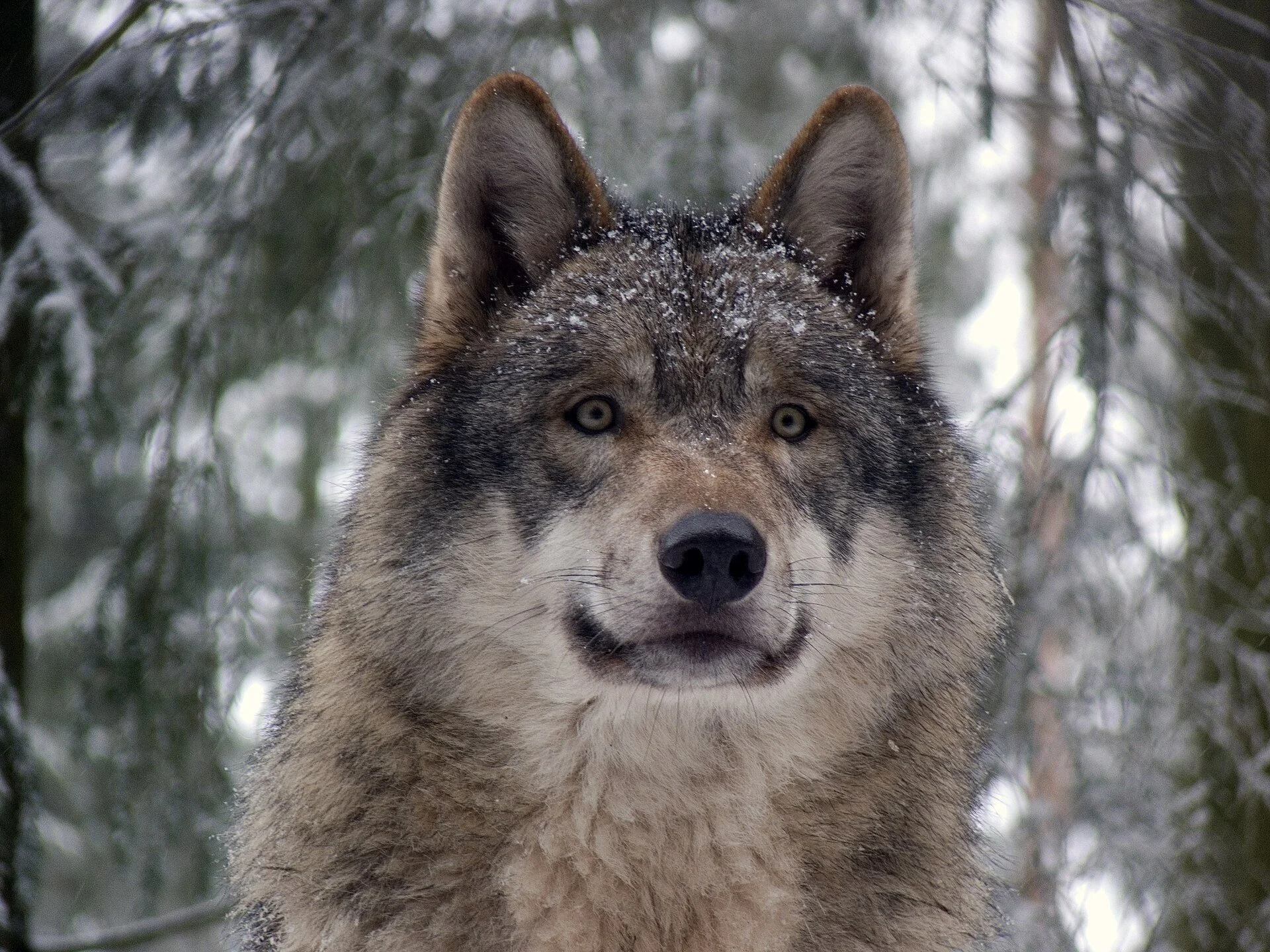
A gray wolf (Canis lupus) stands in the snow. Credit: Gunner Ries Amphibol, CC BY-SA 3.0
America’s iconic gray wolf and the Mexican gray wolf could soon lose their federal protections after President Donald Trump signed a controversial executive order on September 4, aimed at supporting ranchers and boosting beef production.
The Interior Secretary Doug Burgum has now been given 90 days to evaluate whether or not the animals can be fully delisted or downlisted from the Endangered Species Act (ESA). If it is decided that recovery criteria have been met, Burgum is instructed to then engage with state officials to revise their standards for killing gray wolves and Mexican gray wolves.
Gray wolves are currently classified as endangered across most of the lower 48, and threatened in Minnesota. In the Northern Rocky mountain states of Idaho, Montana, and Wyoming, wolf populations are not protected, and so controlled by the state.
In Montana, state officials admitted recently that they have been overestimating local wolf populations for years. Despite this, the Montana Fish & Wildlife Commission (FWC) voted unanimously to set a higher quota for the upcoming hunting season.
This latest order is not the first time that Trump has sought to remove protections for gray wolves. In November 2020, the U.S. Fish and Wildlife Service (FWS) announced that gray wolves could be hunted, trapped, and poisoned, among other lethal measures.
Their decision was based on the existence and alleged recovery of two core metapopulations in the Northern Rocky Mountains, and the Great Western Lakes region, which the FWS said could sustain populations in the lower 48 over time.
Animal advocacy groups appealed this decision, and on February 10, 2022, Senior District Court Judge Jeffrey White ruled in their favor. White found that the FWS was wrong to simply ‘lump together’ a core population with populations of varying sizes elsewhere. While numbers have increased, gray wolves only occupy 15 percent of their former range.
According to Trump’s executive order, the “lethal takings of gray wolves and Mexican [gray] wolves will assist ranchers in combating predation.”
However, conservationists argue that wolf attacks on livestock are rare. For example, in 2015, a major federal study of cattle deaths across the U.S. found that 0.009 percent were killed by wolves. Of an inventoried 112.2 million cattle, only 280,570 (0.3 percent) died from predation.
In any case, there are already federal-state programs in place that reimburse ranchers for livestock losses caused by wolves. The Wolf Livestock Loss Demonstration Grant Program also provides funding for preventive, nonlethal measures such as electric fencing, guard dogs, and range riders who patrol areas worst affected by wolf predation.
Some argue that ranchers are facing far bigger problems to their livelihoods than wolf attacks.
“The leading threats to American ranchers, outside of drought, weather, and other calamities, is the Administration itself and their waiver of tariffs on beef imports,” said the Wolf Conservation Center, in a statement.
The executive order is particularly controversial, and unprecedented, in its targeting of Mexican gray wolves, of which there are currently two genetically distinct populations in Arizona and New Mexico, having been reintroduced in 1998 after facing near-extinction. There were 317 Mexican gray wolves as of last year, but conservationists fear that removing protections now would undermine decades of hard work.
“Mexican [gray] wolves are on their way back, but they continue to need the protections afforded by the ESA to truly recover and thrive,” said Sandy Bahr, Director for Sierra Club Grand Canyon chapter. “This executive order is a political stunt at the expense of the wolves and other creatures who depend on the healthy ecosystems wolves help facilitate.”
Michael Robinson, a senior conservation advocate at the Center for Biological Diversity, said: “We’re prepared to prove in court that downlisting Mexican [gray] wolves and a steep increase in killings would not only be cruel but also deeply unwise and illegal”.
Several recent studies have shown that Mexican gray wolves pose a low threat to livestock. At the peak of documented killings in Catron County, New Mexico, federal data revealed that just 0.65 percent of cattle deaths that year (2019) were caused by wolf predation.
A report by the University of Arizona looking at the impacts of Mexican gray wolves on Arizona ranching operations found that “generally at a county or state level, the impacts of wolves are not detectable.” Published last year, the authors concluded that “this finding is consistent with other studies that have found that a small number of producers are heavily impacted while most others experience small impacts or no impacts.”
Please use Species Unite’s free letter tool to reach out directly to your United States Senators and urge them to reject the bill to delist gray wolves. Send your letter here - it takes 30 seconds.
With animal stories making up less than 2% of the news cycle, we're here to fill that gap. Sign up for Species Unite’s weekly news digest.
The animals need a newsroom in their corner
Every week we dig into the animal stories the mainstream news overlooks. Investigations, exposés, legal battles, and victories - none of it happens without your support. A monthly gift of as little as $5 keeps us covering the 98% of animal news the world isn't seeing.
More stories:
Wildlife cameras, night-vision binoculars, GPS devices, fire sensors, and snowshoes are among the items that have been available to borrow free of charge at a new public nature library.