
The world’s largest wild giant tortoise population stands at an estimated 183,000, new study finds
Aldabra’s giant tortoises fell below 1,000 in the 19th century, and a new study now estimates there are 183,000 on the atoll in the Seychelles.
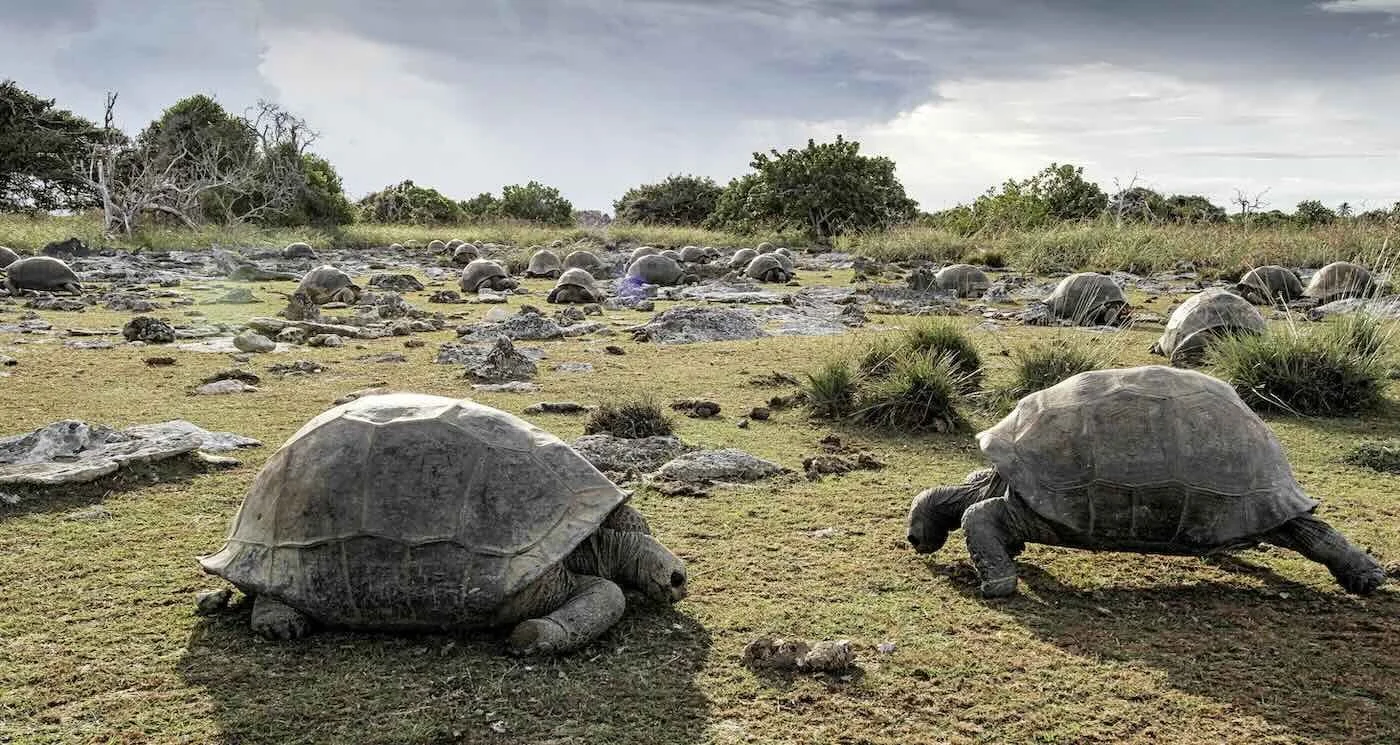
Aldabra Atoll giant tortoises. Credit: SWNS
An estimated 183,000 Aldabra giant tortoises (Aldabrachelys gigantea) live on Aldabra Atoll in the Seychelles, the highest figure ever recorded for the species, according to a study recently published in the scientific journal Ecology and Evolution.
The survey, carried out by the Seychelles Islands Foundation (SIF) and the University of Exeter, is the first update since the widely cited estimate of about 100,000 tortoises from the late 1990s, say the authors, who collected sighting data on the free-roaming giant tortoises every day between 2018 and 2022.
This is also the first time that researchers have utilized modern technology – specifically Bayesian Hierarchical Distance Sampling, which corrects for missed or undetected tortoises.
Previous estimates lacking such technology have been hampered by the fact that tortoises are difficult to spot, as they spend much of their time foraging or finding shade among dense vegetation.
“More than 180,000 giant tortoises roaming freely on our atoll is proof of what long-term commitment to conservation can achieve,” said Dr. Frauke Fleischer-Dogley, CEO of Seychelles Island Foundation (SIF), who worked on the paper with staff from the University of Exeter, Cornwall. “This is wonderful news for Seychelles, for the world, and for everyone who has worked to protect Aldabra.”
There are two remaining giant tortoise populations – the Aldabra population, and a much smaller Galápagos population, of around 20,000, on the Galápagos Islands.
Heavy exploitation of giant tortoises by sailors during the 19th century saw the Aldabra population fall below 1,000, and in Picard, one of Aldabra’s four islands, the population disappeared completely.
One of the world’s largest raised corral atolls, Aldabra has since benefitted from notable protections, such as being declared an IUCN Strict Nature Reserve in 1981, a UNESCO World Heritage Site in 1982, and a Ramsar Site in 2010, while the SIF has monitored the Aldabra giant tortoise population since 1979, maintaining a permanent research station on Picard. Such conservation efforts are the main reason for the giant tortoise’s current stability and abundance, say the authors.
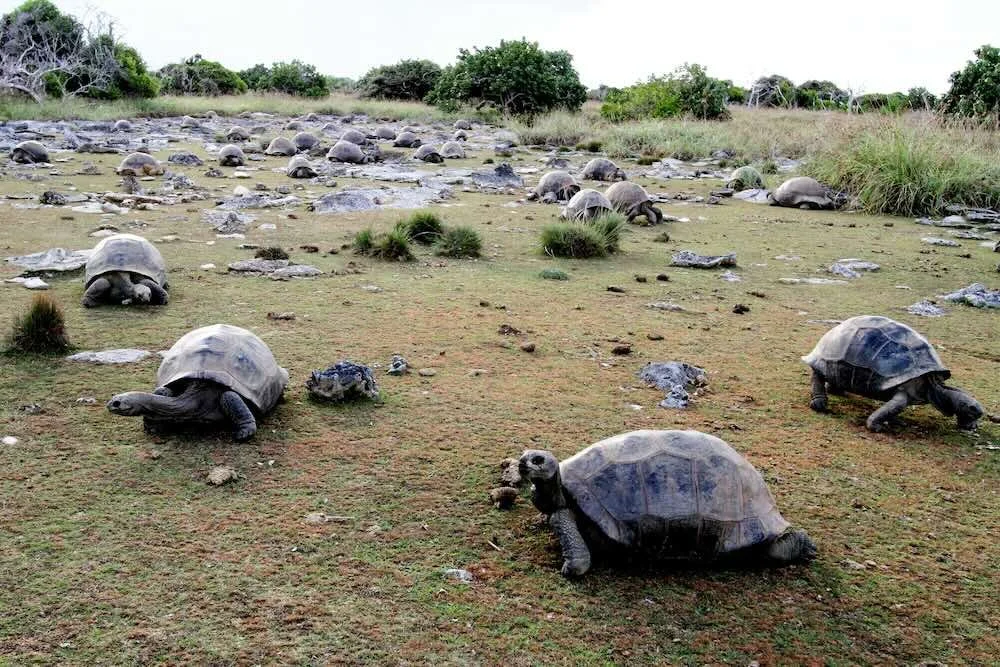
Aldabra Atoll giant tortoises. Credit: Dennis Hansen/SWNS
As megaherbivores, the Aldabra giant tortoise plays a crucial role in the atoll’s ecosystem by moving seeds, depositing nutrients, and disturbing soils. For example, a Seychelles magpie-robin can often be seen feeding on the insects that are disturbed when a giant tortoise stomps along the ground.
Their skills are also useful for rewilding projects on other islands in the Indian Ocean that are without megaherbivores. Notably, their role as seed dispersers has helped to restore the population of critically endangered ebony trees in Ile aux Aigrettes, off the coast of Mauritius.
However, experts are keen to warn against complacency, especially as new threats emerge.
“These results are great news for the tortoises and testament to the fantastic work done in the field, but it’s important to remember that the numbers provide a baseline – not an endpoint,” said Dr. Dave Hudson, Postdoctoral Research Associate at the University of Exeter. “Hopefully we have provided the conservation managers the evidence they need to track future change and act early as the tortoises face increasing pressures from climate change, drought, and invasive species.”
Historically, feral goats posed the biggest threat to giant tortoises, but they were eradicated from Aldabra in 2012. Today, feral cats and black rats, both known to eat tortoise eggs and hatchlings, frequent the atoll.
In addition, climate change means that sea levels will rise, affecting low-lying areas of the atoll, while droughts are predicted to increase in both duration and frequency.
With animal stories making up less than 2% of the news cycle, we're here to fill that gap. Sign up for Species Unite’s weekly news digest.
The animals need a newsroom in their corner
Every week we dig into the animal stories the mainstream news overlooks. Investigations, exposés, legal battles, and victories - none of it happens without your support. A monthly gift of as little as $5 keeps us covering the 98% of animal news the world isn't seeing.
More stories:
Aldabra’s giant tortoises fell below 1,000 in the 19th century, and a new study now estimates there are 183,000 on the atoll in the Seychelles.