
Fraud and corruption cannot be ruled out, says a new report looking into Cambodia’s monkey trade with the US
Key recommendations have not been implemented, according to CITES, with evidence that endangered long-tailed macaques are taken from the wild and funneled into Cambodia’s breeding farms.
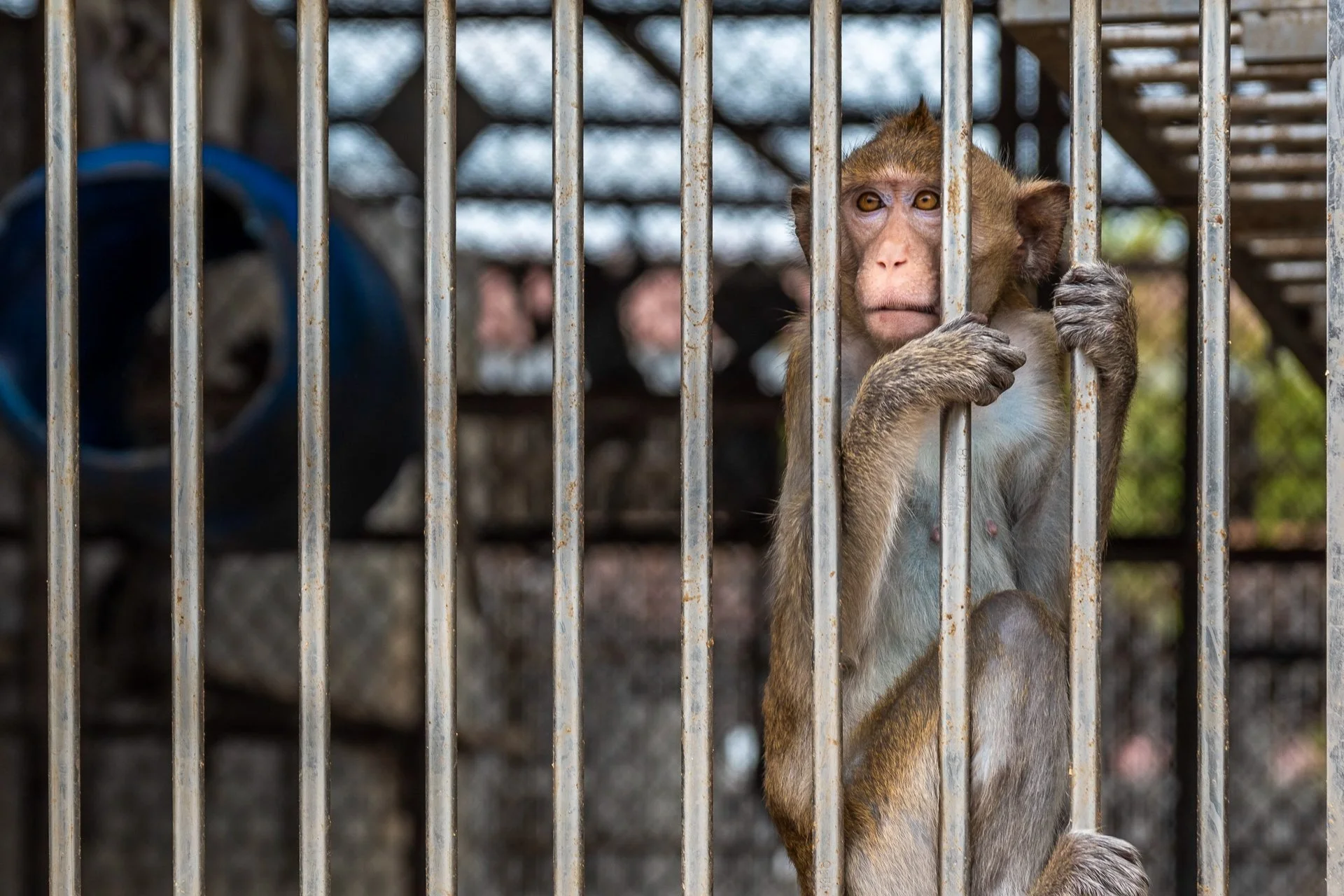
A macaque inside a breeding facility in Cambodia. Credit: AJones
A damning report has concluded that the occurrence of fraud or corruption in the trade of long-tailed macaques from Cambodia for scientific research in the U.S. “cannot be ruled out.”
Published by the Convention on International Trade in Endangered Species (CITES), the report makes clear that many of its previous recommendations from last year have not been implemented by Cambodian authorities.
One of the biggest problems concerns the definition of ‘wild-caught’ macaques. In April of this year, Cambodia authorized the removal of 45 macaques from public areas for transfer to a commercial breeding facility.
According to the report, Cambodia does not regard animals captured in public areas as ‘wild.’ However, in the context of CITES, any animal that is not produced with human intervention or in a controlled environment is considered ‘wild.’ Therefore, if these animals or their offspring are exported, a science-based non-detriment finding (NDF) must be undertaken.
The importance of an NDF was explained on “several occasions” to the Cambodian authorities, and to the managers of the country’s four main breeding farms.
Without an NDF, there is no way of knowing whether the removal of wild macaques will threaten the survival of this endangered species. As such, the report makes clear that the 45 macaques taken from public areas should not be exported, and furthermore, they and their offspring must be clearly separated from the farm’s other breeding stock.
The report also recommended that breeding farms microchip each macaque. This would replace the current practice of applying neck tags, which is open to misuse. In fact, previous CITES recommendations that all neck tags be systematically destroyed after export has yet to take full effect. And although Cambodia confirmed that two breeding facilities have started microchipping, completion is not expected until the end of 2028.
The CITES Secretariat further recommended that to improve traceability and regulatory oversight, each facility should maintain an up-to-date list of the total number of macaques in its care, including the number of reproductive and non-reproductive individuals. Although Cambodia says that the facilities have agreed to this, the CITES report concluded that it is too early to assess whether this recommendation has been implemented.
In light of these findings, PETA has written an open letter to the U.S. Health and Human Services Secretary Robert F. Kennedy, Jr. demanding that the U.S. suspends the importation of macaques from Cambodia. Kathy Guillermo, the animal rights organization’s Senior Vice President, explains that 3,340 monkeys have been imported to the U.S. from Cambodia in the past 11 months, many of whom could be carrying diseases.

A macaque inside a breeding facility in Cambodia. Credit: AJones
CITES opened its review in 2024, following a five-year investigation by the U.S. Fish and Wildlife Service (FWS), which led to the eventual indictment, in 2022, of eight individuals who were allegedly part of a smuggling operation that saw wild-caught macaques taken from Cambodia’s national parks and protected areas to breeding facilities, and given false CITES export permits from corrupt officials. According to the FWS, around 30,000 wild-caught monkeys entered the U.S. under false ‘captive-bred’ paperwork – a violation of both national and international law.
In 2022, the IUCN escalated the conservation status of long-tailed macaques from Vulnerable to Endangered, and upheld this decision in 2025, after an assessment found that wild populations had dropped by 50–70% over the past three decades.
Various reports have revealed a rampant poaching trade across Southeast Asia, with the proliferation of major breeding farms in Cambodia, Laos, and Vietnam during the past six years. This is due to a decision by China – previously the world’s primary exporter of macaques for research – to ban export of the species in early 2020, amid the race to find a vaccine for Covid-19.
The prices paid by biomedical companies are now at an all-time high, with macaques fetching as much as $10,000 each.
Watch and share: 30,000 Monkeys in Our Backyard. This Species Unite short documentary exposes the hidden realities of the animal research trade and reveals what happens when corporate power meets small-town America.
The FDA Modernization Act 3.0 would end a federal mandate that experimental drugs must be tested on animals before they are used on humans in clinical trials. To support this legislation, you can reach out to your representatives here.
With animal stories making up less than 2% of the news cycle, we're here to fill that gap. Sign up for Species Unite’s weekly news digest.
The animals need a newsroom in their corner
Every week we dig into the animal stories the mainstream news overlooks. Investigations, exposés, legal battles, and victories - none of it happens without your support. A monthly gift of as little as $5 keeps us covering the 98% of animal news the world isn't seeing.
More stories:
Wildlife cameras, night-vision binoculars, GPS devices, fire sensors, and snowshoes are among the items that have been available to borrow free of charge at a new public nature library.