
The National Institutes of Health had previously refused to relocate the chimpanzees due to concerns over their old age and poor health, which a judge ruled unlawful.
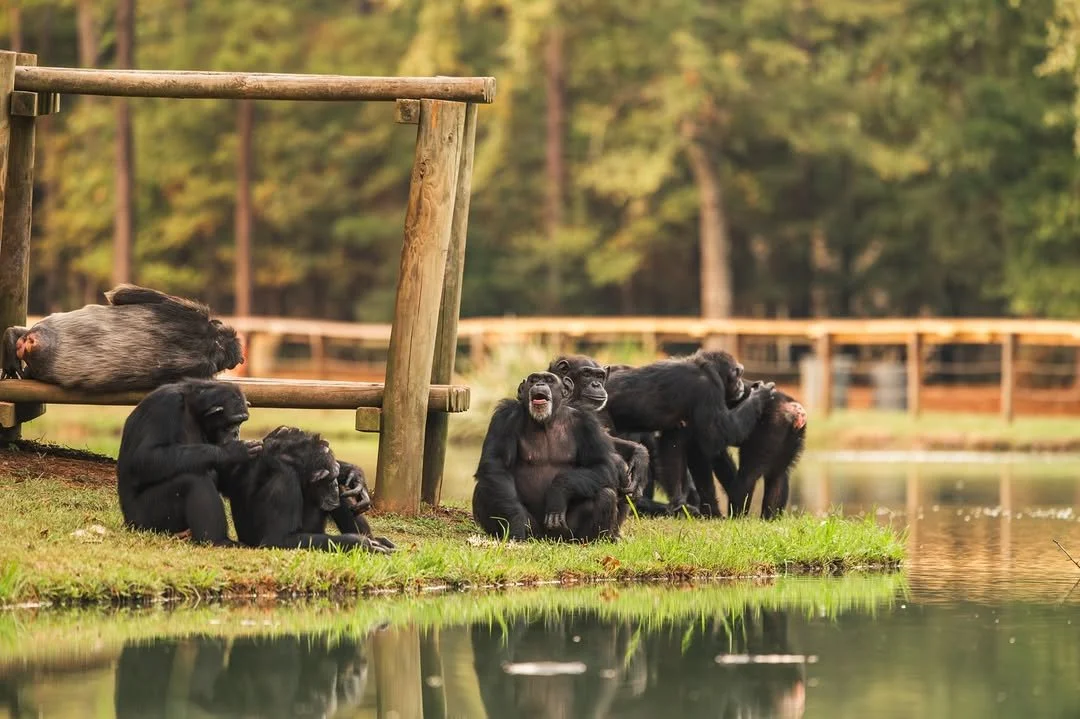
Rescued chimpanzees at Chimp Haven, a chimpanzee sanctuary in Louisiana. Credit: Chimp Haven
The last remaining chimpanzees held in government-owned research laboratories will soon be transferred to a sanctuary, ending a long-running dispute over their fate. All 33 chimpanzees at the Keeling Center for Comparative Medicine and Research (KCCMR) in Bastrop, Texas, are due to move to Chimp Haven, a 200-acre sanctuary in Keithville, Louisiana, next year.
In a statement, National Institutes of Health (NIH) director Jay Bhattacharya said the transfers would fulfil the commitment made back in 2015 to retire all NIH-owned chimpanzees to sanctuary.
Reacting to the news, Sara Amundson, president of Humane World Action Fund, acknowledged the importance of sustained advocacy, legal action, and public pressure in making the transfers possible.
“For decades, we have worked alongside congressional champions, legal advocates, and hundreds of thousands of supporters to ensure that government-owned chimpanzees once used in experiments receive the sanctuary retirement promised to them under federal law,” said Amundson, in a statement. “We are deeply grateful to NIH for making this decision and helping end a dark period in our government’s history of animal experimentation.”
33 chimpanzees will transfer from a Texas laboratory facility to Chimp Haven in Louisiana. Credit: Chimp Haven
Under the Chimpanzee Health Improvement, Maintenance, and Protection (CHIMP) Act, which passed in 2000, all surplus, federally-owned chimpanzees must be retired to a sanctuary. In November 2015, NIH announced that it would no longer support any biomedical research on chimpanzees, and that it had developed a plan for the relocation of all of the approximately 300 NIH-owned chimpanzees to Chimp Haven – the only federal chimpanzee sanctuary – over the next decade.
However, in 2019, NIH announced that 44 chimpanzees at the Alamogordo Primate Facility (APF) in New Mexico would not be transferred, due to concerns over their poor health and old age (many were in their 50s and 60s).
The Humane World for Animals (HWA; formerly Humane Society of the United States), Animal Protection New Mexico, and other plaintiffs, filed a lawsuit against NIH in 2021. Further controversy erupted later that year, when the NIH veterinary panel advised against transferring 52 chimpanzees from KCCMR. According to the panel, the physiological stressors associated with transportation and quarantine could trigger fatal medical events, since many of the animals were geriatric and suffering from serious health conditions including epilepsy, cardiovascular disease, and diabetes, with several on Quality of Life plans.
In December 2022, a district judge ruled that NIH was wrong to prevent chimpanzees from moving to a sanctuary on the grounds of old age and poor health. Explaining her decision, Lydia Kay Griggsby wrote: “The CHIMP Act makes clear that Congress recognized that older and sicker chimpanzees … would enter the federal sanctuary system.”
Although 14 chimpanzees had died by the time of this ruling, all of the remaining animals in APF were successfully moved to Chimp Haven, between January and April 2025.
Among the first to arrive was Kamaka, a wild-caught, 55-year-old male. In the NIH panel assessment, Kamaka was described as having advanced cardiovascular disease as well as poorly regulated hypertension and lumbar osteoarthritis, and it was felt that the physiological and psychological stressors associated with transportation, quarantine, change in social structure, and change in human care provider could trigger a fatal cardiac event.
Posting an update four months into life at Chimp Haven, sanctuary staff say Kamaka has settled in “wonderfully” with a new family, and might even be harboring a mutual crush on one of the females.
Chimp Haven – which is currently home to nearly 300 chimpanzees formerly used in biomedical research – is now preparing to transport and receive the KCCMR population, with the first batch of arrivals expected in January. The sanctuary explained that while the transfers are not without risk, Chimp Haven offers the chimpanzees an opportunity for new beginnings, complete with specialist, individualized care.
Among the KCCMR chimpanzees is Bria, a 31-year-old female, who – according to HWA – had her spleen removed as part of an experiment, and who later bit through the skin of her own arm to remove a birth control implant. While most of the chimpanzees were bred in laboratories, Tanya, a 57-year-old female, was captured from the wilds of Africa, and has spent 45 years languishing in American laboratories.
“It will be superexciting when the last chimpanzee makes its way here,” said Chimp Haven president Rana Smith. “It’s the end of an era.”
With animal stories making up less than 2% of the news cycle, we're here to fill that gap. Sign up for Species Unite’s weekly news digest.
The animals need a newsroom in their corner
Every week we dig into the animal stories the mainstream news overlooks. Investigations, exposés, legal battles, and victories - none of it happens without your support. A monthly gift of as little as $5 keeps us covering the 98% of animal news the world isn't seeing.
More stories:

The killings were described as “an abomination,” while experts doubt the ‘official’ killing methods, arguing that the 12 pups were likely to have been killed in their dens.