
AI-powered robots that their maker calls "senior veterinarians" are monitoring millions of pigs in China, and an advocate who saw the system says it tracks health but not welfare.
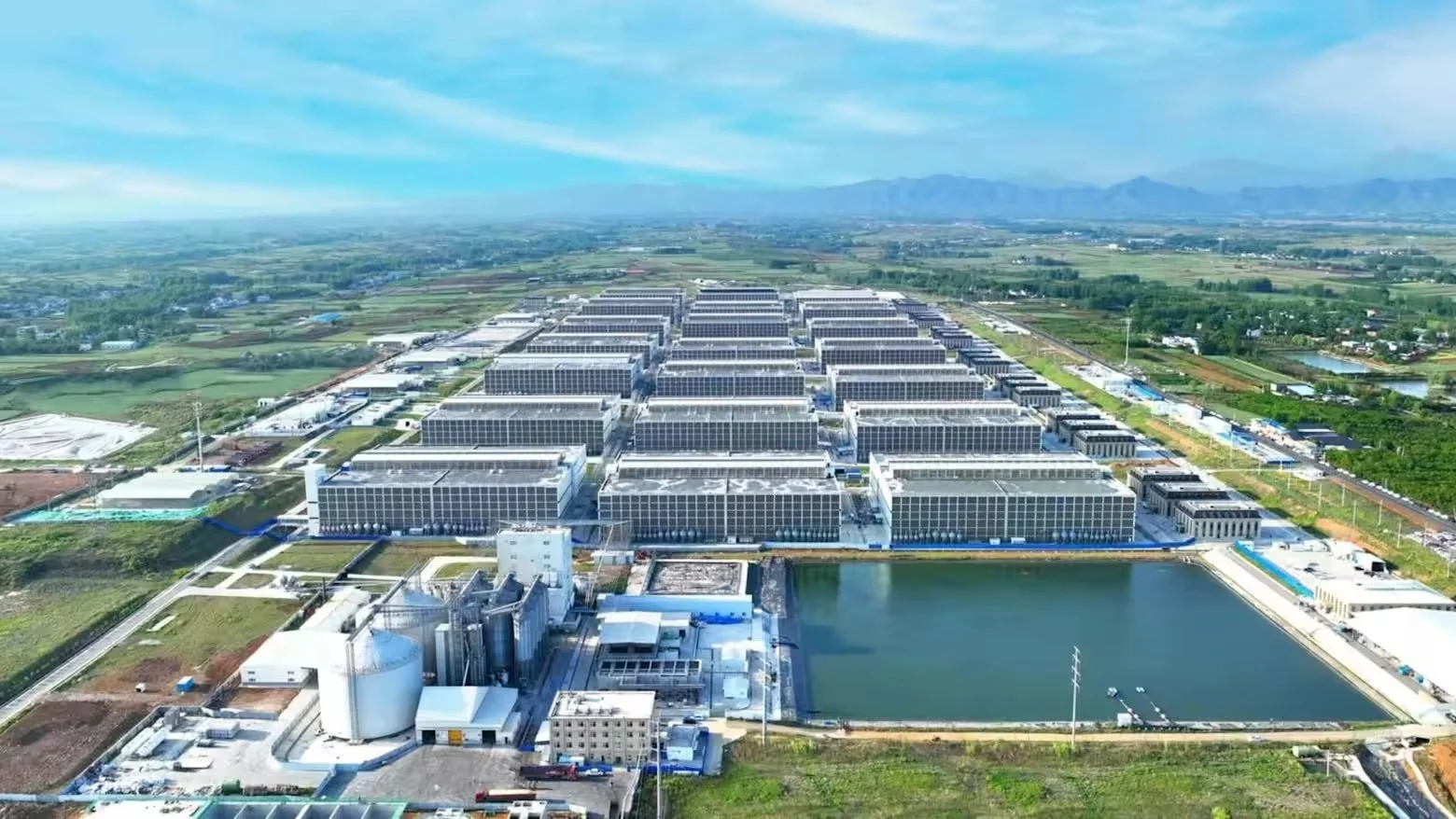
An AI-powered pig production facility run by Muyuan Foods in Neixiang County, Henan Province, China. Credit: Muyuan Foods
AI-powered robots are monitoring millions of pigs on farms run by Muyuan Group, China's biggest pork producer, which says the system detects illness earlier, while a farm animal advocate who saw it at a trade show says it measures nothing about the animals' welfare.
At the animal-farming trade show EuroTier, held from November 10 to 13, 2026, in Hanover, Germany, the company showed off its new system, which it says runs 30 buildings, each containing 100,000 pigs.
“Managing this number of pigs and the size of our farms is a real challenge to our company,” said Muyuan Group president Gao Tong earlier this year, claiming that the robots would allow for earlier illness detection in the animals. Mortality rate and antibiotic use on farms have been reduced thanks to AI use, according to Gao.
The company refers to the robots as “senior veterinarians”, but author and former president and CEO of Mercy For Animals and author Leah Garces, who visited the trade fair and talked to Muyuan representatives, raises alarms about true insight into animal welfare: “Watching for sickness and temperature changes is not the same as welfare. Health means the pig isn’t sick. Welfare means a life worth living. Do they play? Do they root? Do they have positive social lives? From what I could see, nothing on that screen was measuring any of it. It was about feed conversion, getting more animals to market, and needing fewer workers.”
While artificial intelligence can help detect signs of illness in animals, it can also contribute to making cramped, over-crowded mega-farms more commercially effective, which may be to the detriment of animals who already live lives that are highly unnatural and far removed from anything that makes life worth living to them.
China’s factory farming industry has already ventured into the AI sector: a pig farm in Yangcheng has used a robot to collect data about animal behavior, water and food consumption, as well as temperature. This year, scientists in Beijing deployed a six-axis robot arm powered by AI to automate vaccinations for pigs on a factory farm.
But as AI is built and programmed for efficiency, animals’ true well-being may be set aside in favour of financial gain. In a paper on AI and factory-farming ethics, researchers argued that the discomfort and suffering of animals on factory farms are already well known and researched, and that resources would be better used to prevent these issues.
“There is no need for an advanced machine learning algorithm to realize (and respond to) the pain of animals,” the researchers write. “Disease, poor housing, painful routine practices, bad handling and parturition cause pain.” The paper also argues that using AI to detect pain reduces the discovery to only what AI can measure, potentially missing suffering that is less easy to detect.
With animal stories making up less than 2% of the news cycle, we're here to fill that gap. Sign up for Species Unite’s weekly news digest.
The animals need a newsroom in their corner
Every week we dig into the animal stories the mainstream news overlooks. Investigations, exposés, legal battles, and victories - none of it happens without your support. A monthly gift of as little as $5 keeps us covering the 98% of animal news the world isn't seeing.
More stories:


AI-powered robots that their maker calls "senior veterinarians" are monitoring millions of pigs in China, and an advocate who saw the system says it tracks health but not welfare.