
Recent heatwaves killed up to three million chickens in France alone
Record-breaking temperatures caused the death of millions of birds on French factory farms.
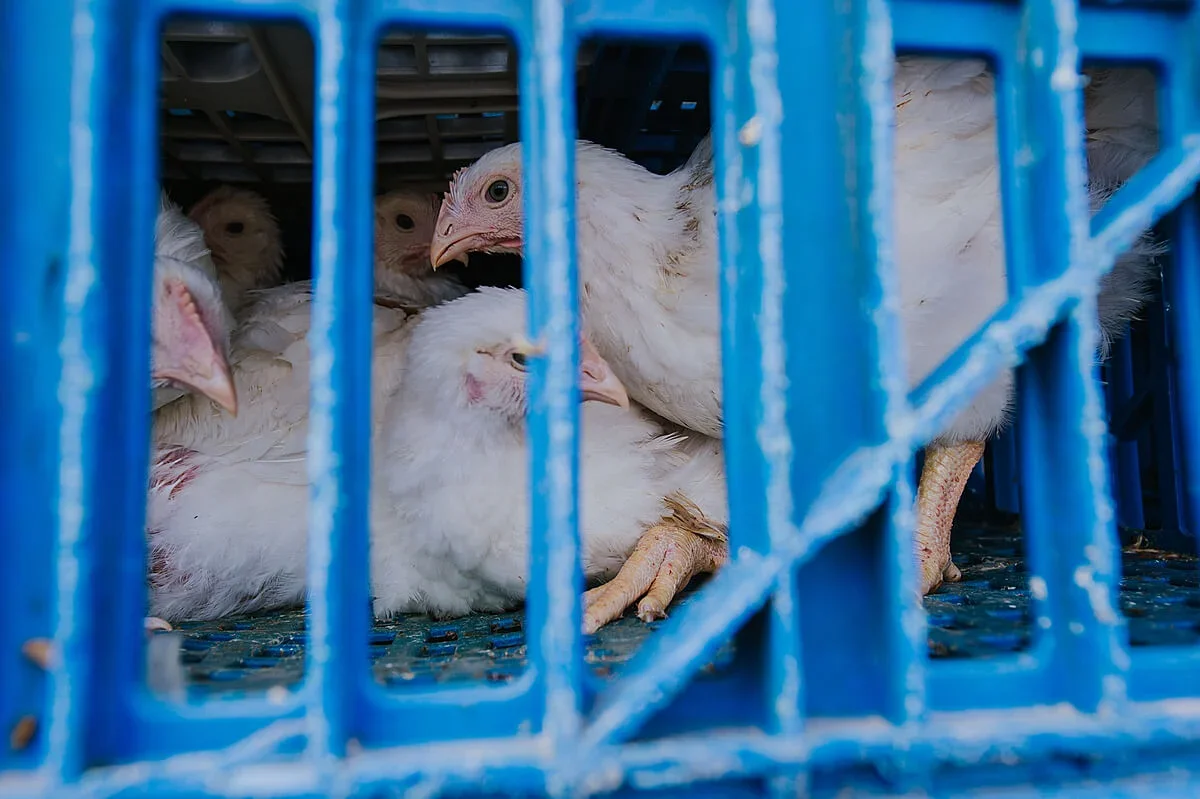
Photo: Victoria de Martigny / We Animals
Nearly three million broiler chickens died in France alone during Europe's late-June heatwave, Le Monde reports.
Temperatures climbed to more than 40°C (104°F) across the continent this summer, killing more than 10,000 people and decimating livestock across France, Poland, and Spain, three of Europe's largest poultry producers.
The deaths were concentrated in the Brittany region, home to France's largest broiler chicken operations.
France, Poland, and Spain are among Europe’s biggest poultry producers, together farming over 2.6 billion chickens annually. All three have been significantly affected by soaring temperatures this summer.
Scientific organization World Weather Attribution, which studies the impact of climate change on extreme weather, has said that the heatwave would be “virtually impossible” without human-caused climate change, adding that climate change is “unequivocally to blame” for the severity of the heatwaves.
Animal agriculture has been consistently identified many times as one of the leading causes of the climate emergency. Factory farming - which already causes animals lifelong suffering due to extreme confinement, risk of diseases, painful mutilations, and a stressful, often violent death - is exacerbated by heatwaves.
Animals are unable to cool off the way humans do, and the situation is particularly dire for chickens. A Poultry Science review found that broiler chickens under the stress of extreme heat were four times more likely to die as other chickens held at more comfortable temperatures.
Mortality rates spike whenever temperatures do, a pattern that is becoming increasingly frequent as the climate crisis intensifies.
In 2025, Compassion in World Farming (CIWF) published a report into the ways extreme weather events linked to the climate crisis impact farmed animals. The report found that rising temperatures can seriously harm animals, causing breathing and heart problems, dehydration, weaker immunity, reduced fertility, and more. In some cases, it could be fatal.
“Factory farming contributes significantly to climate change, and, as temperatures rise, animals trapped in factory farms suffer even more,” states CIWF. “Millions of animals are confined in overcrowded sheds, left without enough water, and transported in vehicles where temperatures can become dangerously high.”

French organization Welfarm has called for urgent action to be taken, such as reducing crowding on farms, offering open-air access, adapting animal housing standards, and allowing animals more chances to express natural behaviors.
Welfarm are also calling for a ban on transporting animals in hot weather conditions. Since being released in 2020, their TRUCKalert app has received more than 1,200 reports and helped identify more than 600 trucks transporting animals in unsafe and potentially unlawful conditions.
The app allows for reporting of animals transported in France in heat more than 30°C (86°F), which could be in violation of animal protection rules - official guidelines from 2022 call for a heat-adjusted vehicle to be used if animals are to be transported in temperatures above 30°C.
Join Species Unite's 30-Day Plant-Powered Challenge, a free month of recipes and tips to help you reduce demand for factory farmed animals, one meal at a time.
We Have A Favor To Ask…
Species Unite amplifies well-researched solutions to some of the most abusive animal industries operating today.
At this crucial moment, with worldwide momentum for change building, it’s vital we share these animal-free solutions with the world - and we need your help.
We’re a nonprofit, and so to keep sharing these solutions, we’re relying on you - with your support, we can continue our essential work in growing a powerful community of animal advocates this year.


Some developers suggest that adopting cultivated meat could also improve animal welfare by significantly reducing the number of farmed animals slaughtered.