
US federal agencies roll back definition of "harm" under Endangered Species Act
More than 1,600 critically imperiled species are now at further risk, after a new federal policy narrowed what counts as harming an endangered species.
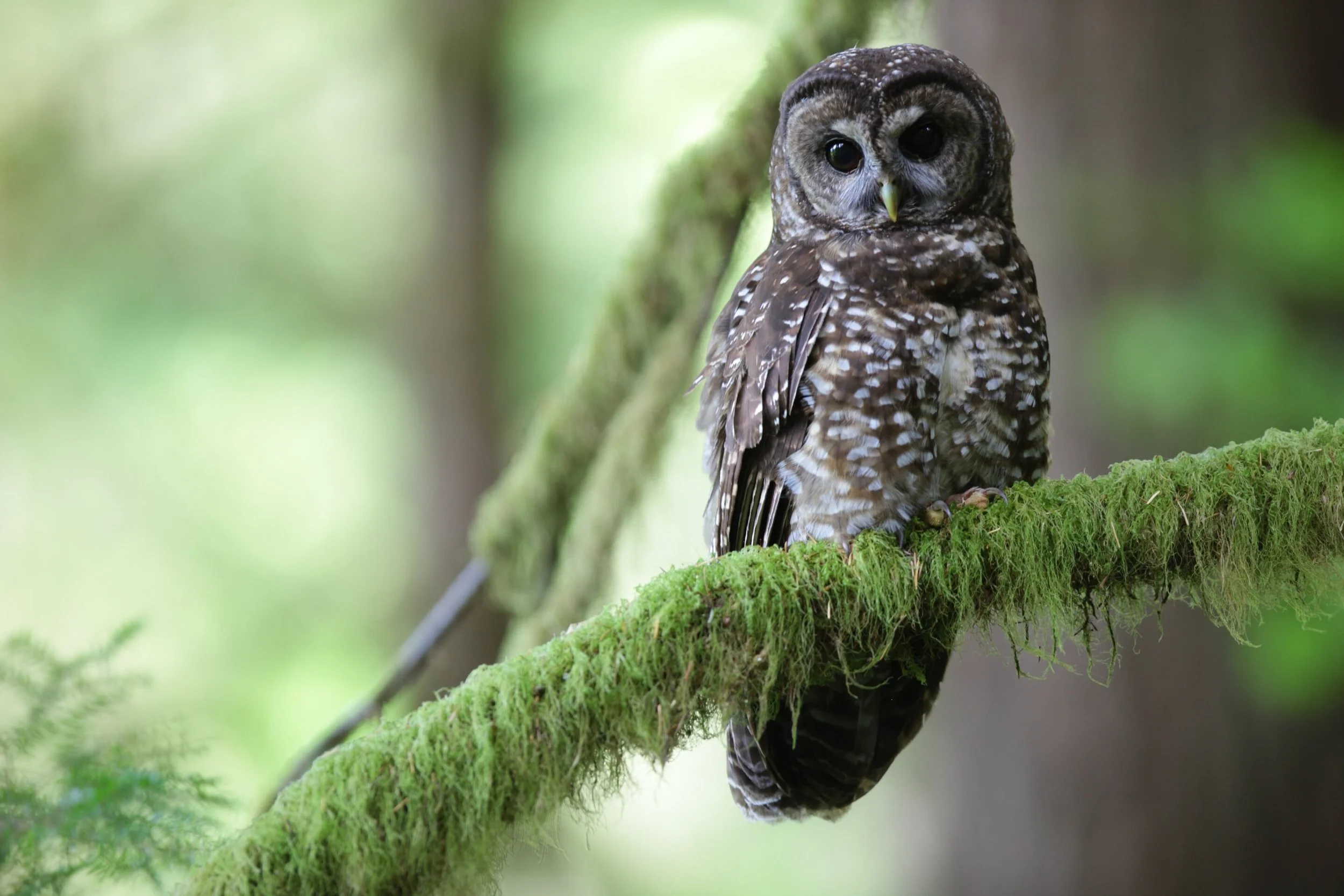
A northern spotted owl (Strix occidentalis caurina) sits in a tree. Credit: Chris McCafferty. Oregon State University, CC BY-SA 2.0
Under a new federal policy, accidentally killing, harming, or harassing a protected species will no longer count as a violation of the Endangered Species Act (ESA), as long as the act wasn't deliberate.
The change comes from the Fish & Wildlife Service (FWS) and National Marine Fisheries Service (NMFS), which have both indicated they are adopting this narrower reading of the law.
On September 14, FWS Director Brian Nesvik distributed a memo to his staff redefining “harm” under the law to include only an “act that is intentionally and purposefully directed at a particular animal.”
Nesvik called that the “best reading of the statute,” the standard the U.S. Supreme Court set when it overruled a previous decision. Nesvik adopted the definition the late Justice Antonin Scalia used in a dissent in Babbitt v. Sweet Home Chapter of Communities for a Great Oregon, the 1995 case in which the court upheld ESA rules that included indirect harm, specifically habitat modification, as illegal under the act.
“Unless you’re wearing a T-shirt that says, ‘I’m here to draw the blood of endangered species,’ you’re basically off the hook,” said Brett Hartl, government affairs director with the Center for Biological Diversity, a conservation nonprofit told the Spokesman-Review. “Wink, wink, nudge, nudge, go crazy, we’re not gonna prosecute you.”
On the same day, the National Marine Fisheries Service (NMFS) at the National Oceanic & Atmospheric Administration (NOAA) adopted the same policy in a memo sent to regional staff from NOAA General Counsel John Luce. The memo was marked “CUI (Controlled Unclassified Information) & Privileged – Attorney Client & Attorney Work Product – FOIA Exempt,” but was released to the Center for Biological Diversity under a Freedom of Information Act request.
When asked about the memo, NMFS (also known as NOAA Fisheries) Public Affairs Director John Chu, told Species Unite “that is not what I know. We are not putting out anything externally about that.” Regarding FWS, Chu gave us a statement saying “NOAA cannot comment on the policy decisions of other agencies.”
FWS is charged with enforcing ESA on land and sky, while NMFS does by sea.
Under the new definition, FWS would consider it a violation of the law when an “actor deliberately acts on an animal…(shooting, netting, trapping, poisoning, harassing) or because he intends to “get at” the animal (felling the tree or draining the pond to get at particular animals).” The harm needn’t be immediate (poisoning, trapping would qualify), but the target would have to be a specific individual, not a “population,” habitat or unoccupied potential habitat.
“When that purpose is absent, there is no take, however serious the resulting injury may be. A vessel that inadvertently strikes a whale has not taken it, because the vessel’s course was not set against the whale. Felling a tree is not a take of the bats roosting in it unless the tree is felled for the purpose of killing or capturing them,” according to Nesvik’s memo.
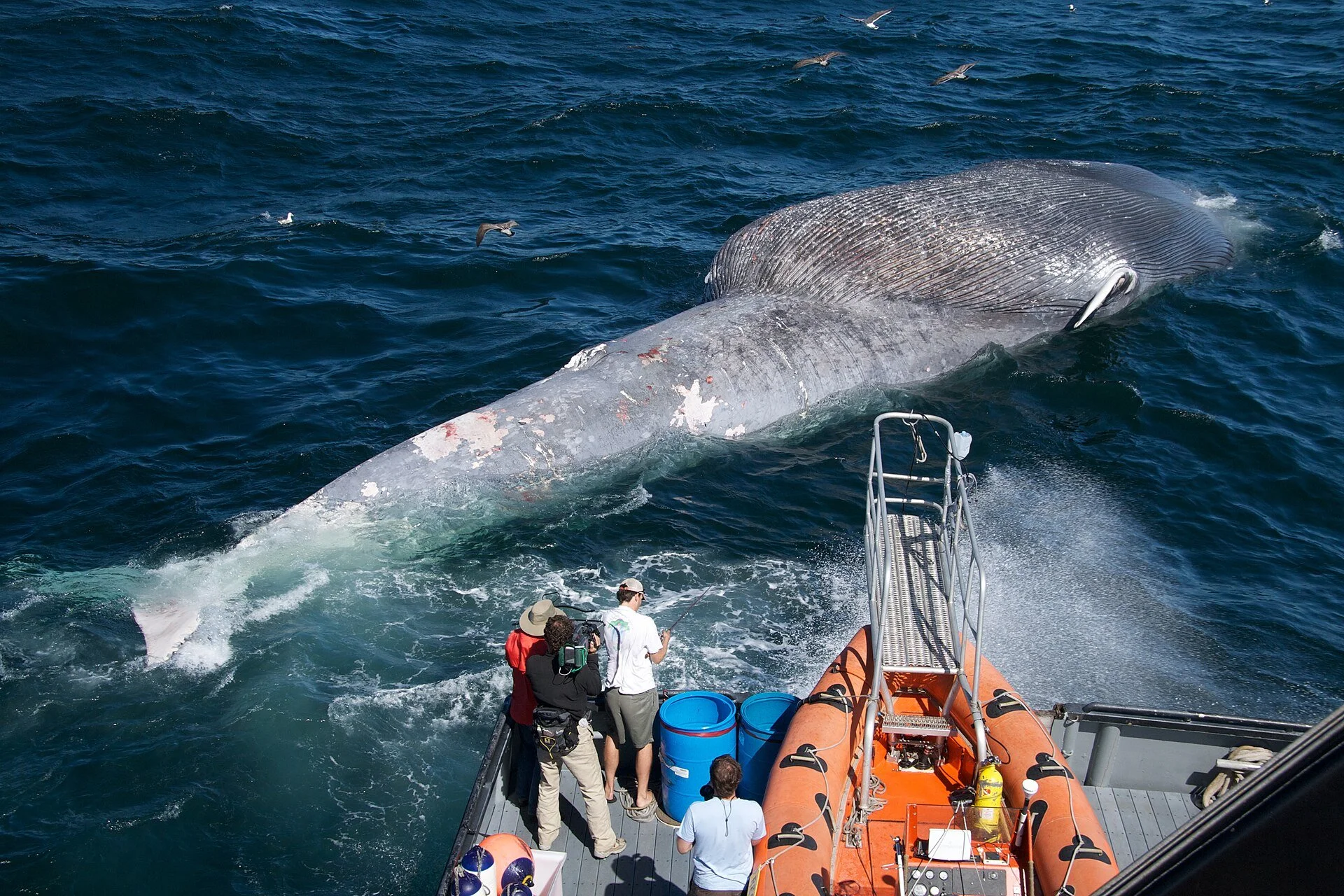
Researchers examine a dead blue whale killed from a collision by a ship. Credit: Craig Hayslip, Oregon State University Marine Mammal Institute, CC BY-SA 2.0
The memo says that not understanding the law is not a defense but not knowing the facts may be. “The hunter who shoots an elk believing it a mule deer…has not committed a "knowing" violation…because he does not know what sort of animal he is shooting."
Nesvik’s memo came out the same day the Trump administration’s reinterpretation of ESA, which says that altering the environment of a protected plant or animal is not prohibited, announced in July, took effect. It follows a pattern of efforts by the administration to strip endangered species of protection, including cutting the budget, exempting the Gulf of Mexico from ESA, allowing economic considerations when listing species for protection (though the law says only scientific data apply) and issuing rules designed to speed resource development at the expense of native species.
Conservationists say the new policy could open the door to further habitat loss. Since felling a tree is no longer legally classified as a "take" unless done to intentionally kill a bird or mammal in it, logging companies may now be able to clear active nesting sites of the northern spotted owl (Strix occidentalis caurina) without violating the law. The owl is listed as “threatened,” or in danger of becoming endangered. It survives in British Columbia, Washington state, Oregon and Northern California but not in all of its historic range. And though FWS determined that the species should be listed as “endangered,” in 2020, the status was never changed. “We find that reclassification to endangered status for the delta smelt and northern spotted owl are currently warranted but precluded,” FWS stated a year ago.
The marbled murrelet (Brachyramphus marmoratus), another threatened bird from the same zone (plus Alaska), spends a lot of time at sea looking for fish to eat, but nests primarily high in trees. “Marbled murrelet populations are in steady decline, due in part to the clearing of old-growth temperate rainforests, habitat shared with the imperiled northern spotted owl,” according to the American Bird Conservancy. Under the new guidance, a company that cuts down a murrelet's nesting tree while the bird is elsewhere foraging would not be considered in violation of the law, since the intent was logging rather than harming the bird.
It remains unclear whether a federal agency can change policy like this without a public comment period or advance notice. But the agencies “have adopted an extraordinarily narrow view of what constitutes 'take.' They have turned Congress's intent on its head,” stated Jane Davenport, lawyer for Defenders of Wildlife. “They are overturning 50 years of interpretation.” She pointed out that when Scalia wrote his opinion 31 years ago that the agencies rely on, he was outvoted 6-3. The court later overturned that decision.
It is currently not known how FWS and NMFS will implement the policy. “Your guess is as good as mine,” said Davenport.
Earthjustice, an environmental law firm, immediately pledged to “see the Trump administration in court about this.”
Keep watch of the habitat of any endangered animals in your area, and any planned construction projects. State and local authorities still may maintain authority to protect wildlife. Contact local officials if you know that a planned shopping center is going to drain the wetlands, pond, or forest.
With animal stories making up less than 2% of the news cycle, we're here to fill that gap. Sign up for Species Unite’s weekly news digest.
The animals need a newsroom in their corner
Every week we dig into the animal stories the mainstream news overlooks. Investigations, exposés, legal battles, and victories - none of it happens without your support. A monthly gift of as little as $5 keeps us covering the 98% of animal news the world isn't seeing.
More stories:
Significant investment and revised regulations across four government agencies are part of an ongoing effort to support innovative scientific research ahead of “outdated” testing on animals.