
Scientists implant human brain tissue into mice, raising ethical concerns
A new study has implanted human brain tissue into bioengineered mice, leading to debate over animal welfare.
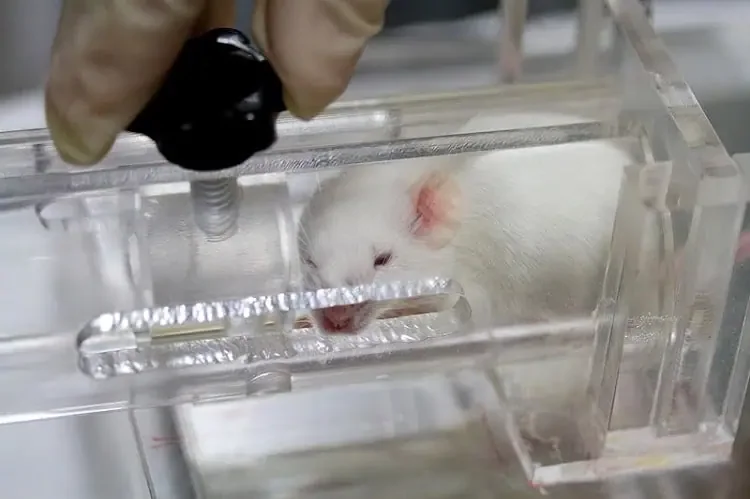
A mouse in a box for an experiment. Studies estimate111 million mice and rats are used annually in U.S. biomedical research alone.
Scientists have implanted laboratory-grown human brain cells into mice in what they say is an effort to more closely understand conditions such as schizophrenia, dementia, epilepsy, and cerebral palsy.
By implanting human brain tissue, known as neural organoids, into animals engineered to be born without a cortex or hippocampus, experimenters can now research how human brain cells behave in a live organism.
"The space normally occupied by the mouse cortex allowed us to transplant human cortical organoids shortly after birth and gave the human tissue room to grow extensively," said Stanford University neuroscientist Sergiu Pașca, senior author of the study published in the journal Nature.
Pașca said that a priority of the study was to “make aspects of human brain development and function accessible for investigation.”
Professor Madeline Lancaster, group leader at the MRC Laboratory of Molecular Biology in Cambridge, is skeptical that this technique will teach much about real human brain development: "It's less clear to me how this will inform our understanding of human brain development since it is rather artificial, and not at all like how the brain develops naturally."
The research team has also previously implanted human neurons into the brains of rats.
These clusters of stem cell-derived tissue, engineered to replicate the structure and function of the human brain, are used to study disease and test new drugs. Their use has ignited debate around the welfare of the animals involved.
"Animal welfare is a really important concern, and it will be necessary to closely monitor these animals in order to evaluate the impact on them," said Emily Jackson, professor of law at the London School of Economics and chair of a recent report on neural organoids for the Nuffield Council on Bioethics.
Many researchers working on organoids are also working on growing them in vitro, outside a living organism, using cells or biological molecules.
Investigations into animal experimentation have repeatedly found that mice and rats suffer greatly from living in a laboratory. Over 111 million mice and rats are used in US laboratories each year, and undercover investigations have found that animals are sometimes denied basic care such as adequate food, water, and veterinary care. During their lives, animals are commonly deprived of anything that makes life worth living for them, spending their entire existence in a small, barren cage. When the experiment is terminated, they are often killed.
The research comes as U.S. regulators are pushing away from animal testing methods altogether.
This week, the Food and Drug Administration (FDA) introduced updated regulations to accelerate alternatives to animal-based experimentation. The new regulations state that non-animal methods can be used where appropriate when testing drugs and biological products intended for human use.
The update is intended to reflect advances in technology that have allowed new innovative research methods to become available, such as organ-on-a-chip technologies, computer models, human cells, and more.
The update removes language that suggests animal use is the only acceptable method of producing safety information for regulatory decisions on products intended for human use. It doesn't prohibit or limit animal studies, but rather expands and makes space for other models.
The FDA has also launched a database of New Research Methodologies (NAMs), which features a range of in vitro, in silico, and in chemico studies to support the 3Rs (Reduce, Refine, and Replace) approach to animal-based research.
Under the updated regulations, researchers may use these methods, and draw data from them, when validated and considered appropriate.
Watch and share: 30,000 Monkeys in Our Backyard. This Species Unite short documentary exposes the hidden realities of the animal research trade and reveals what happens when corporate power meets small-town America.
The FDA Modernization Act 3.0 would end a federal mandate that experimental drugs must be tested on animals before they are used on humans in clinical trials. To support this legislation, you can reach out to your representatives here.
With animal stories making up less than 2% of the news cycle, we're here to fill that gap. Sign up for Species Unite’s weekly news digest.
The animals need a newsroom in their corner
Every week we dig into the animal stories the mainstream news overlooks. Investigations, exposés, legal battles, and victories - none of it happens without your support. A monthly gift of as little as $5 keeps us covering the 98% of animal news the world isn't seeing.
More stories:


As opposition to octopus farming grows worldwide, Colombia is moving to ban the practice before a single farm is built.