
Three of the world's five rhino species are thriving while two face extinction, new report finds
Although three species of rhino are benefiting from anti-poaching efforts and rewilding initiatives, there is much concern over the future of Sumatran and Javan rhinos.
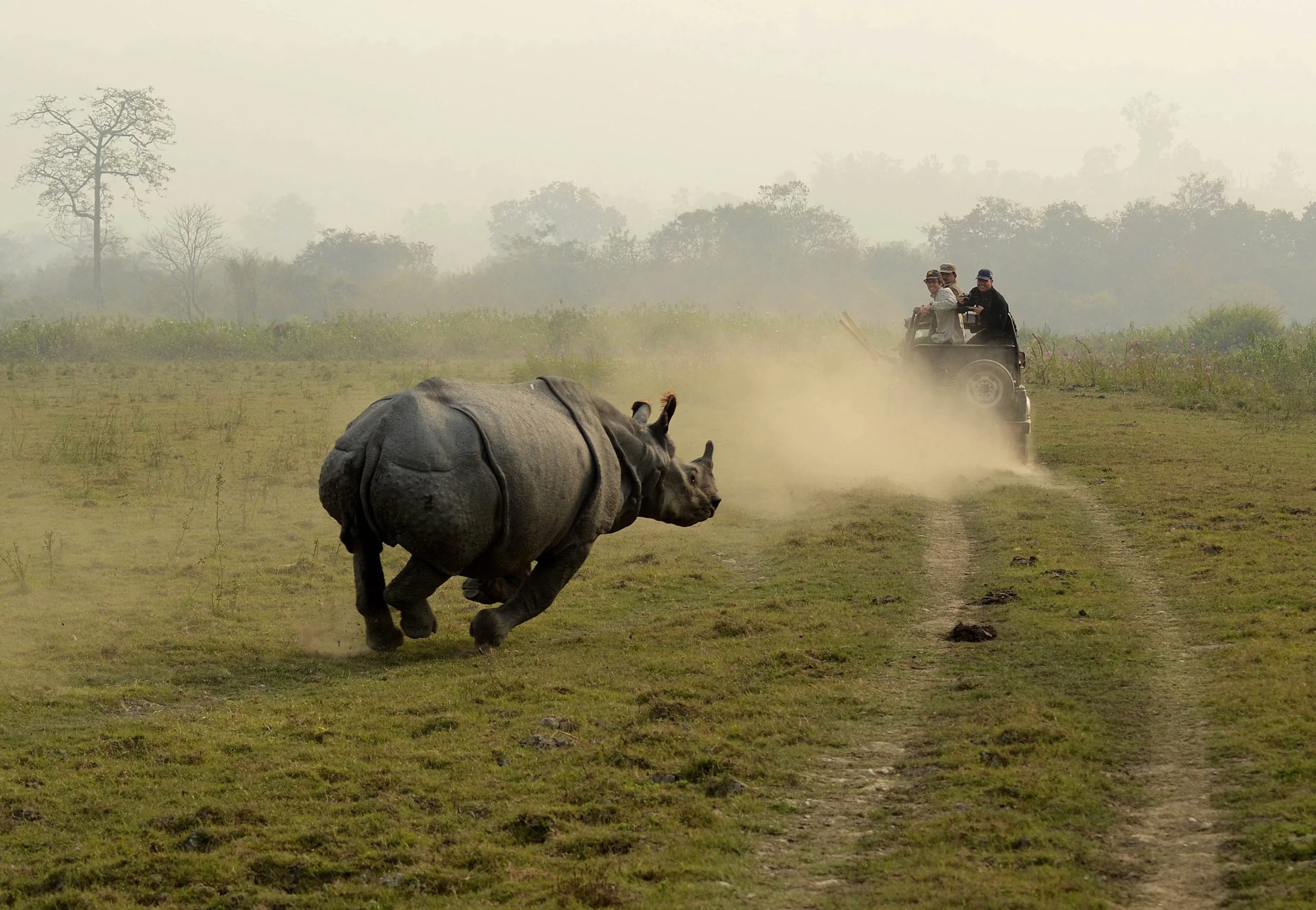
A greater one-horned rhino (Rhinoceros unicornis) chasing a tourist safari vehicle in India's Kaziranga National Park. Credit: International Rhino Foundation
Three of the world's five rhino species are recovering dramatically, while two others may not survive much longer, according to a new report, leading to a split verdict that has left conservationists with "mixed emotions.”
“State of the Rhino,” released by the International Rhino Foundation (IRF), details threats from poaching and the illegal horn trade and spotlights upcoming rhino conservation and policy opportunities.
“On the one hand, the return of greater one-horned rhinos is one of the great conservation success stories of our time, demonstrating what can be accomplished with political will and a lot of collaboration,” said said Nina Fascione, IRF’s executive director. “On the other hand, Sumatran and Javan rhinos are in such a perilous situation. We could conceivably lose these magnificent animals in our lifetimes – it’s very troubling.”
Classified as Critically Endangered on the IUCN Red List, Javan rhinos (Rhinoceros sondaicus) live only in Ujung Kulon National Park, on the Indonesian island of Java, having disappeared completely from northeastern India, Bangladesh, Burma, and most recently, Vietnam in 2010.
The population has stayed below 100 for the past 25 years, not helped by the fact that as many as 26 were poached between 2019 and 2023. While no killings were reported last year, the current population of 50 Javan rhinos in Ujung Kulon face more intrinsic threats, such as an uneven ratio of males and females, as well as a lack of genetic diversity.
Similarly, Sumatran rhinos (Dicerorhinus sumatrensis) live in fragmented rainforest habitats across the Indonesian islands of Sumatra and Kalimantan, making it difficult for breeding-age animals to meet. The population has dropped to as low as 34, down from more than 300, in 2005.
Such reproductive challenges mean that both species need the assistance of captive-breeding, says Fascione. “The Sumatran Rhino Sanctuary in Way Kambas National Park has done such an excellent job breeding Sumatran rhinos that we’re racing to expand enclosure space for future calves or wild-caught animals in this semi-wild facility.” Ten rhinos are currently living at the sanctuary.
“The government of Indonesia is working hard on strategies to save them, and they’re backed by scientists, global funders, and other conservationists,” added Fascione.
The greater one-horned rhino (Rhinoceros unicornis), Asia’s third species of rhino, shows that recovery is possible. Residing in India and Nepal, the greater one-horned rhino population now stands at 4,075 – up from 2,500 in 2005, and from as little as 100, in the mid-1990s.
Much of this success is due to a crackdown on poaching syndicates. A decade ago, the Indian state of Assam – home to 80% of the world’s greater one-horned rhinos – lost nearly 30 poached rhinos in a single year, but zero killings were reported in 2025. Nepal, too, recorded zero killings in 2025, and is in fact the first country in the world to report zero poaching of rhinos, tigers (Panthera tigris), and elephants (Elephas maximus) simultaneously. The Nepalese government often delegates forest protection to local communities, which not only provides financial incentive for residents but encourages genuine interest in conservation.
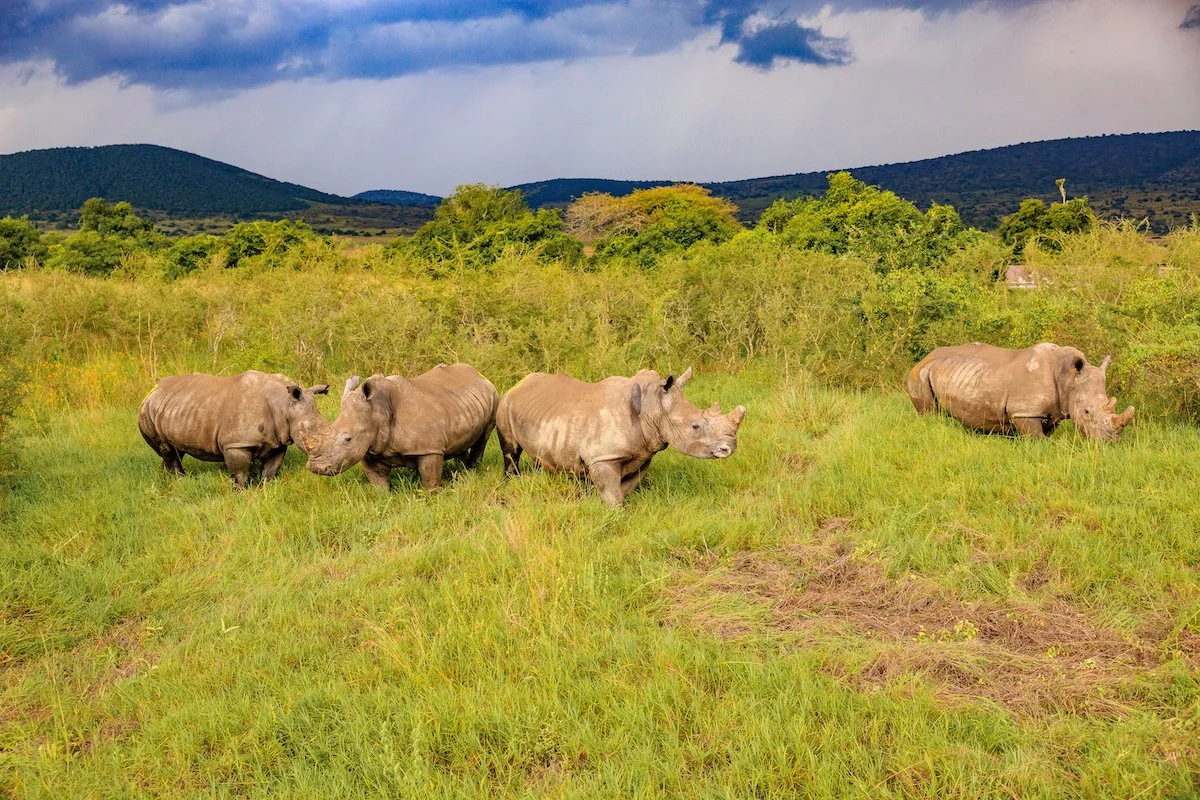
A group of southern white rhinoceroses (Ceratotherium simum simum) translocated to Akagera National Park in Rwanda as part of a conservation initiative in 2025. Credit: Rwanda Development Board
Meanwhile anti-poaching efforts continue to prove effective across Africa. Of 16 countries, eight reported zero rhino killings in 2023/2024, while five countries reported two killings or less. Poachings in Namibia – home to 3,598 rhinos – decreased by 53% between 2024 and 2025, with 41 killed last year. As of April this year, just eight have been lost. In South Africa – which has the biggest population of rhinos, at 14,389 – poaching has dropped from 420 in 2024 to 352 in 2025.
The IRF report refers to “momentous arrests and sentences” made this year, particularly in South Africa. Notably, Sifiso Mbuyane was sentenced in May to 28 years in prison for killing two rhinos in Kruger National Park. When rangers made the arrest, Mbuyane was in the middle of cutting off the horns of a second slain rhino.
The demand for rhino horns continues to be driven by China, either for use in traditional medicine, as status symbols, or in carvings. Rampant poaching across Africa saw the number of black rhinos (Diceros bicornis) plummet from around 100,000 in the 1960s to just 2,300 by the mid-1990s. However, the population has more than doubled in the last 25 years, with a current estimate of 6,788. The IUCN predicts that the population could rise to 8,943 by 2032, if current conservation efforts continue.
White rhinos (Ceratotherium simum) are the most populous of the five species, with 15,752. Listed as Near Threatened by the IUCN, white rhinos have been the main target of poaching in recent years, with numbers having swelled to as many as 21,000 in 2012. A century earlier, poachers had reduced the population to as few as 100.
The IRF report highlights several recent cases of African rhino populations having been successfully rewilded into protected, high-security areas. This includes nine female white rhinos who were moved to Zinave National Park in Mozambique, in June of this year. The park now has 39 white rhinos and 22 black rhinos, with five healthy black rhino calves having already been born there.
And last summer, 70 white rhinos were transferred to Akagera National Park in Rwanda. Poachers had completely wiped out the park’s rhino population during the 1990s, but thanks to increased ranger patrols, stronger law enforcement, and community engagement, Akagera has recorded zero poached rhinos, lion (Panthera leo), or elephant (Loxodonta africana) for the past 15 years.
The U.S. Fish and Wildlife Service (FWS) has the power to stop or severely restrict these imports, close regulatory loopholes, strengthen enforcement, and prevent facilities like Sloth World from obtaining wild-caught sloths. Join Species Unite in calling on the FWS to halt the commercial import of wild-caught sloths into the U.S. and strengthen federal protections to end this trade. Add your name here.
With animal stories making up less than 2% of the news cycle, we're here to fill that gap. Sign up for Species Unite’s weekly news digest.
The animals need a newsroom in their corner
Every week we dig into the animal stories the mainstream news overlooks. Investigations, exposés, legal battles, and victories - none of it happens without your support. A monthly gift of as little as $5 keeps us covering the 98% of animal news the world isn't seeing.
More stories:
Significant investment and revised regulations across four government agencies are part of an ongoing effort to support innovative scientific research ahead of “outdated” testing on animals.