
Among the five captive elephants is former circus performer Joyce, who has been living at Six Fields Wild Safari Adventure in Jackson Township for the past 16 years.
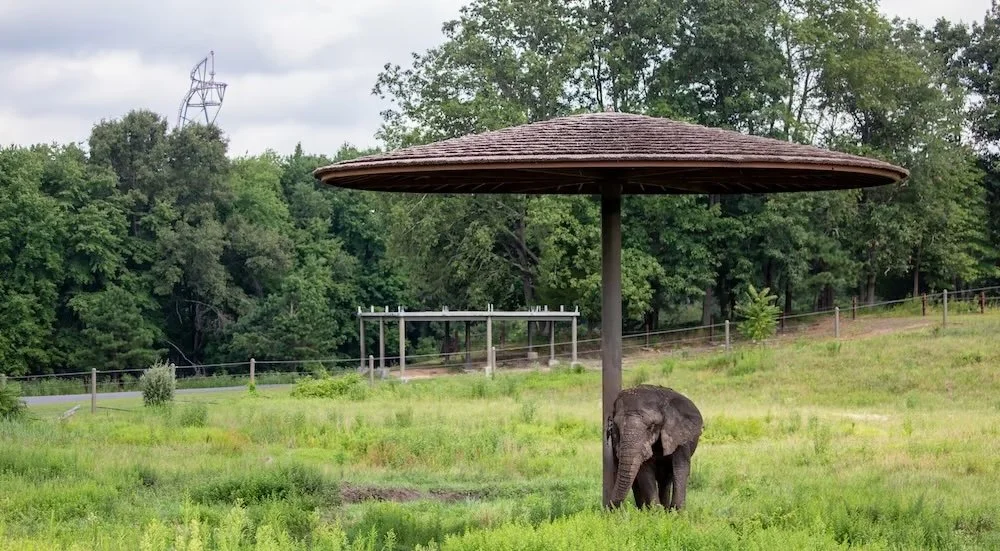
An elephant stands under a shade structure with a roller coaster in the distance. Credit: World Animal Protection
Animal rights campaigners are continuing to protest against the keeping of five elephants at a popular safari park in New Jersey, after federal inspectors found no violations during a recent visit.
Six Flags Wild Safari Adventure in Jackson Township was reported to the U.S. Department of Agriculture (USDA) in September. According to the animal welfare organization World Animal Protection (WAP), the park’s African elephants are being deprived of sufficient shade.
The formal complaint alleged that the outdoor enclosure violates animal welfare laws, which requires shade to be provided. Elephants are particularly vulnerable to heatstroke, given their lack of sweat glands. During the July heatwave, temperatures in Jackson soared to 103 degrees.
Aerial footage captured by WAP and recently posted online shows the Six Flags elephant enclosure. There appear to be no natural or artificial shade structures. Furthermore, at roughly one acre, the space is around 700,000 times smaller than elephants would enjoy in the wilds of Africa, says WAP, who also points to the lack of enrichment for the animals.
However, USDA officials found no noncompliant items during an inspection conducted on October 9. “The health and well-being of our animals remains a top priority, and we unequivocally stand behind the care we provide,” said Ryan Eldredge, a spokesperson for Six Flags.
Liz Cabrera Holtz, the senior programs manager for WAP, argued that the elephants are still “suffering,” despite the report not flagging any violations. “Meeting minimum legal standards does not mean an animal is thriving — or even that their most basic needs are being met,” Holtz told Asbury Park Press. “Unfortunately, the Animal Welfare Act sets an alarmingly low bar for animal welfare.”
The Six Flags safari park is adjacent to Six Flags Great Adventure, an amusement park boasting over 100 rides and 14 roller coasters. Opened in 1974 as a drive-thru experience, the safari park now spans 350 acres containing over 1,000 animals across 11 themed sections such as Baboon Village, Serengeti Grasslands, and Wilde Plains.
“No amusement park can come close to providing the vast space, complex social environments, and opportunities for natural behavior that elephants need to thrive,” said Holtz.
As WAP’s wildlife campaign manager, Nicole Barrantes has been leading a campaign to urge Six Flags to retire the elephants to a sanctuary, which the organization has offered to facilitate and fund. Barrantes said that a warmer state would be preferable, as the elephants are confined to an indoor barn during Jackson’s cold, often snowy winters.
Six Flags “specializes in roller coasters – they don't specialize in animal welfare,” said Barrantes, who adds that the elephants face daily noise pollution, not just from the many rides but from the off road safari trucks.
One of the elephants, Joyce, has been at Six Flags for the past 15 years. Captured as an infant from the wilds of Zimbabwe in 1984, Joyce spent her life performing in U.S. circuses before ending up at Six Flags. Having endured so much, Barrantes says that Joyce deserves to see out her life in a sanctuary.
"The campaign is for all the elephants to go to a sanctuary, but we focus on Joyce in the messaging because we know her story,” Barrantes told Asbury Park Press. “These animals deserve a happy ending. Six Flags is not the happy ending for them.”
Barrantes was speaking to the media on October 24, having joined protestors at the Monmouth Road intersection in Jackson, as weekend visitors made their way to Six Flags.
With animal stories making up less than 2% of the news cycle, we're here to fill that gap. Sign up for Species Unite’s weekly news digest.
The animals need a newsroom in their corner
Every week we dig into the animal stories the mainstream news overlooks. Investigations, exposés, legal battles, and victories - none of it happens without your support. A monthly gift of as little as $5 keeps us covering the 98% of animal news the world isn't seeing.
More stories:
In total, seven people have now admitted to being part of U.S.-wide online chat groups that created, shared, and discussed videos depicting extreme physical and sexual abuse of monkeys.