
US federal health agencies commit millions to phase out animal testing
Significant investment and revised regulations across four government agencies are part of an ongoing effort to support innovative scientific research ahead of “outdated” testing on animals.
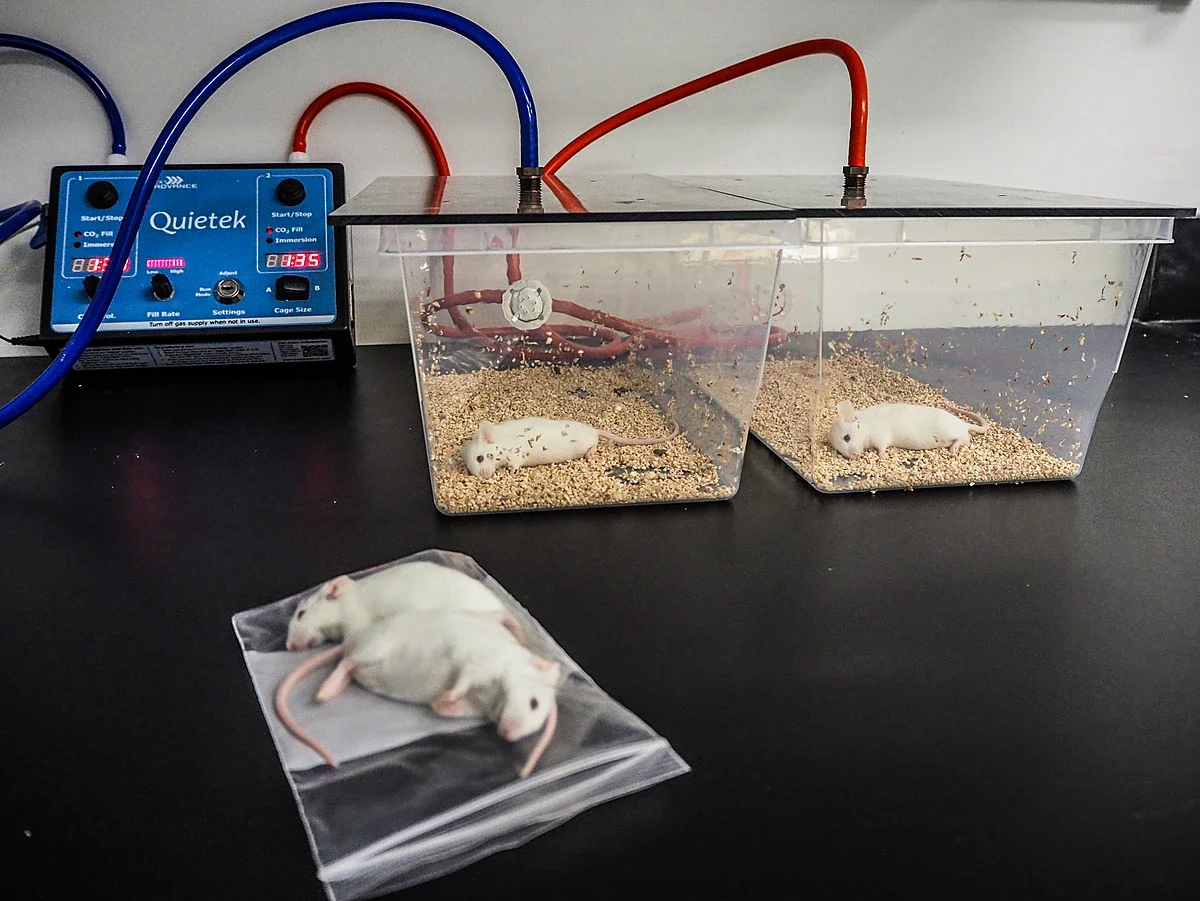
No longer of use for experimentation, laboratory mice (Mus musculus) are asphyxiated by carbon dioxide and then bagged for incineration in the U.S. Mice are some of the most used animals in research. Credit: Roger Kingbird / HIDDEN / We Animals
Tens of millions of dollars in new federal funding, along with updated regulations across four government agencies, are being directed toward replacing animal testing with human-based research methods.
The changes, announced by the U.S. Department of Health and Human Services (HHS), mark a significant investment and policy shift as part of an ongoing effort to modernize how the federal government conducts, funds, and evaluates biomedical research.
"We are moving HHS toward a new era of biomedical research that puts human biology at the center of science," said HHS Secretary Robert F. Kennedy Jr. in a press release. "We are modernizing outdated regulations, investing in human-based technologies, and breaking down barriers that have kept researchers dependent on animal models when better tools are available.
“Under President Trump, we will use the best science to protect patients, accelerate medical breakthroughs, and end unnecessary animal testing," he added.
As a result, the National Institutes of Health (NIH) has announced $88 million in funding for biomedical infrastructure projects nationwide, with a further $7 million to be awarded to projects that show how new kinds of biological data can improve detection and measurement in lab-based New Approach Methodologies (NAMs).
In addition, the NIH plans to open a state-of-the-art laboratory that will enable advanced, animal-free experiments on reproducible human biological systems.
"NIH is building the scientific infrastructure needed to develop, validate, and scale technologies that better reflect human biology," said NIH Director Jay Bhattacharya.
The Food and Drug Administration (FDA) has now updated its regulations to clarify that animal testing is no longer the only approved way to predict real-world drug safety and effectiveness. In line with federal law, this recognizes that nonclinical tests can include organs-on-chips and AI-powered models, among other NAMs.
The Advanced Research Projects Agency for Health (ARPA-H) is investing further in its CATALYST program, developing animal-free methods such as AI and computational modeling to better predict drug safety.
And the Centers for Disease Control and Prevention (CDC) is currently conducting more than a dozen studies using NAMs, while "substantially" reducing its laboratory animal colony.
Earlier this summer, the CDC announced that it would retire up to 162 research monkeys. Talks are ongoing, but the Born Free USA Primate Sanctuary in south Texas remains the front-runner to receive the rhesus (Macaca mulatta) and pig-tailed macaques (Macaca nemestrina).
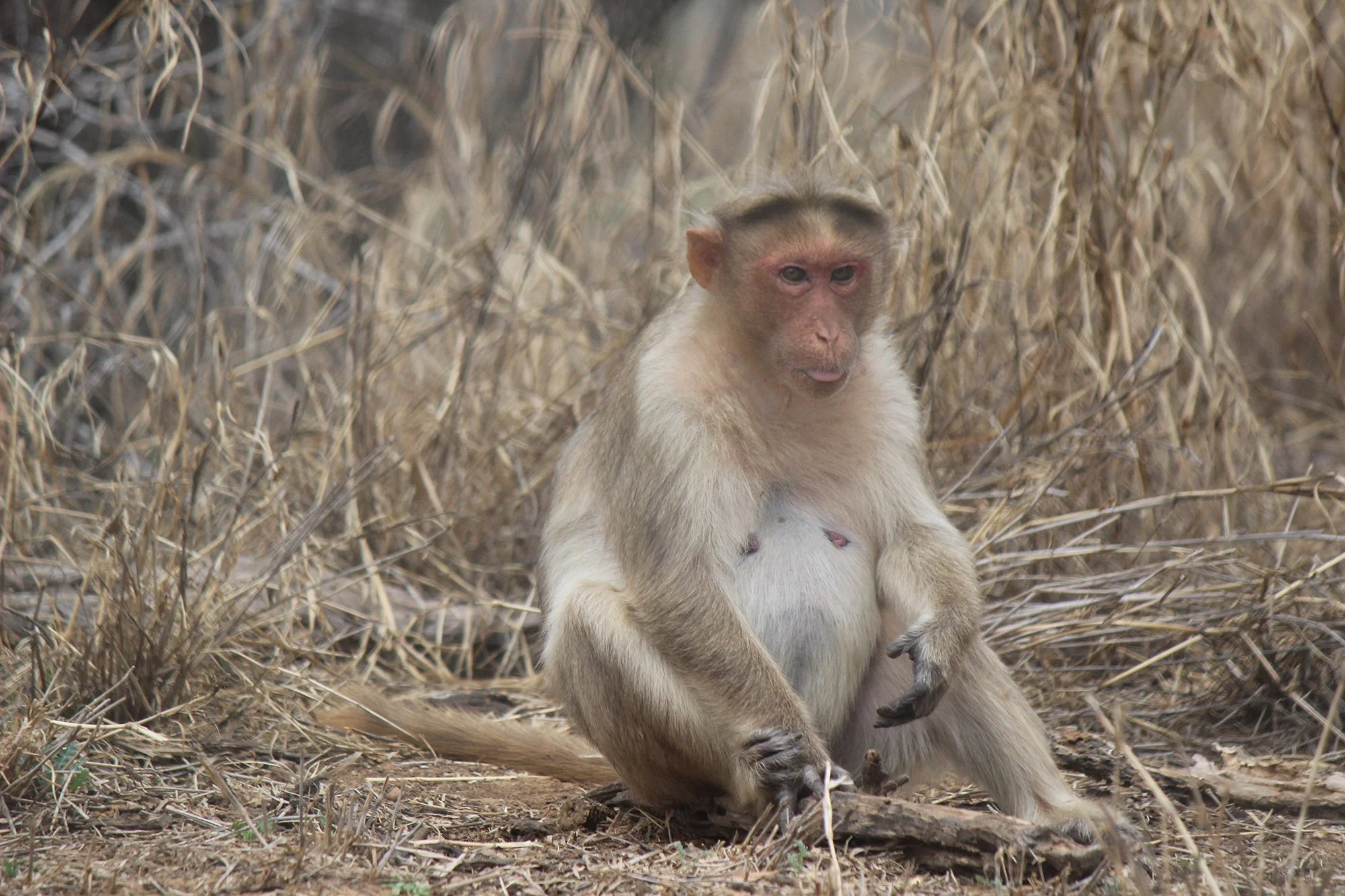
Mig, a female bonnet macaque (Macaca radiata), at the Born Free USA Primate Sanctuary. She arrived with her mother and father in August 2006, as part of a group of bonnet macaques rehomed from animal experimentation. Credit: Born Free USA
Campaigners have long raised concerns over the efficacy and ethics of animal testing. More than 92% of drugs tested on animals fail to pass human trials, and this high failure rate has not decreased in the past 40 years. Most of these failures are due to unexpected toxicity, which only became apparent during human trials.
In July of last year, the NIH and FDA co-hosted a workshop titled "Reducing Animal Testing." One of the speakers, Dr. Nicole Kleinstreuer, NIH Deputy Director for Program Coordination, Planning, and Strategic Initiatives, said she wanted to not only shut down all animal labs, but develop long-term, animal-free solutions that would prevent any new animal labs from opening.
The NIH has since shut down its last beagle laboratory, and began talks on transitioning one of the country's largest monkey research centers — the Oregon National Primate Research Center, which houses nearly 5,000 nonhuman primates and receives 84% of its $60 million annual budget from the NIH — into a sanctuary.
Watch and share: 30,000 Monkeys in Our Backyard. This Species Unite short documentary exposes the hidden realities of the animal research trade and reveals what happens when corporate power meets small-town America.
The FDA Modernization Act 3.0 would end a federal mandate that experimental drugs must be tested on animals before they are used on humans in clinical trials. To support this legislation, you can reach out to your representatives here.
With animal stories making up less than 2% of the news cycle, we're here to fill that gap. Sign up for Species Unite’s weekly news digest.
The animals need a newsroom in their corner
Every week we dig into the animal stories the mainstream news overlooks. Investigations, exposés, legal battles, and victories - none of it happens without your support. A monthly gift of as little as $5 keeps us covering the 98% of animal news the world isn't seeing.
More stories:
Significant investment and revised regulations across four government agencies are part of an ongoing effort to support innovative scientific research ahead of “outdated” testing on animals.