
Colombia bill could ban intensive octopus farming before it starts
As opposition to octopus farming grows worldwide, Colombia is moving to ban the practice before a single farm is built.
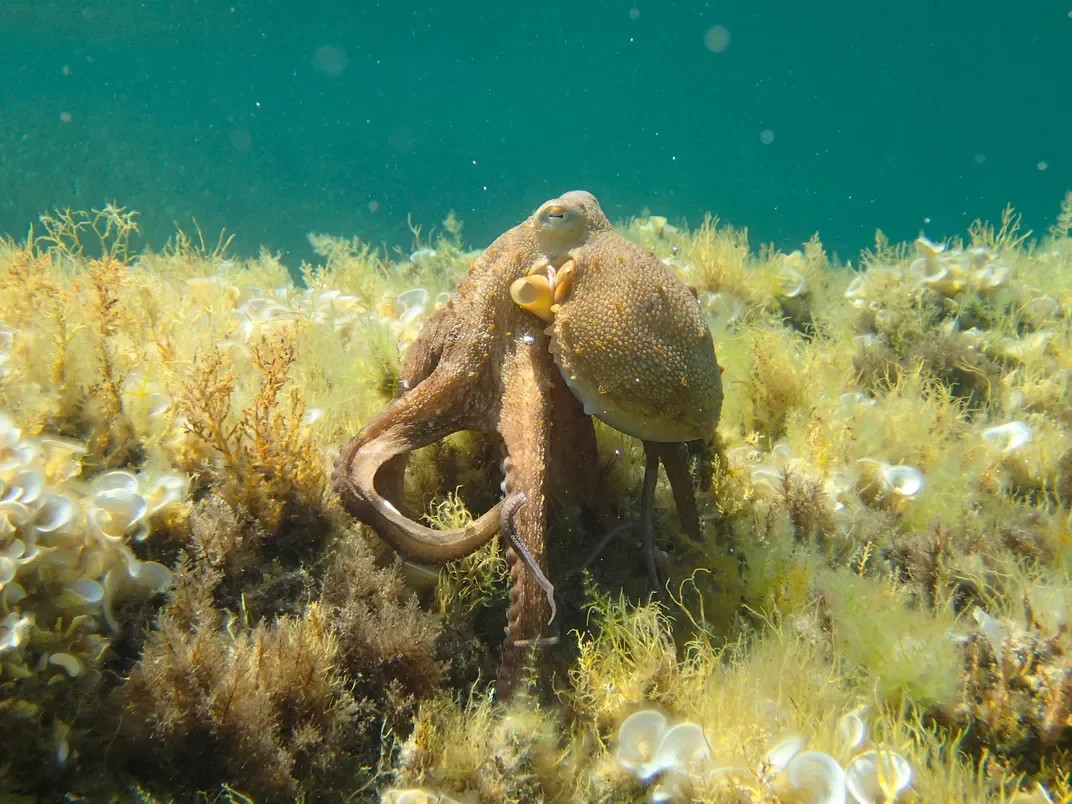
A common octopus (Octopus vulgaris), the most widely consumed octopus species, camouflaged on a rocky, weed-covered seabed. Credit: Emanuele Santarelli, CC BY-SA 4.0, via Wikimedia Commons
Colombia could become the first country to ban intensive cephalopod farming, after a new bill targeting the practice was introduced in the country's Senate.
Introduced by Senator Yuly Esmeralda Hernández Silva in July, the bill would see a federal ban on the intensive farming of cephalopods, including octopus, cuttlefish, and squid. It was published in the Colombian Congressional Gazette in August and is currently going through the Senate legislative process.
Seven other legislators beyond Hernández Silva signed the bill, which aims to prohibit the farming of these animals on Colombian territory for the food industry, as well as prohibit imports of products originating from intensive cephalopod farms abroad, among other provisions.
While it would effectively prohibit the farming of cephalopods, it places no restrictions on catching these animals in the wild.
Breaching the law would be punishable by fines, as well as an immediate suspension of farming activity.
There is currently no octopus industry in Colombia, meaning that this new legislation would be entirely preventative.
This news follows reports that Spanish company Nueva Pescanova’s plans to build the world’s first commercial octopus farm were called off earlier this year. Animal advocates in Spain and abroad celebrated the decision, as Nueva Pescanova’s plans had attracted ample criticism due to ethical concerns as well as worries regarding biodiversity conservation.
“Octopuses can anticipate a painful, difficult, stressful situation – they can remember it,” said Dr. Jennifer Mather of the University of Lethbridge in Canada. "There is absolutely no doubt that they feel pain. Not only that, but they learn to avoid sites where pain has been inflicted on them."
Mather is among the petitioners, organized through Harvard Law School, calling on the National Institutes of Health to include cephalopods among the animals entitled to humane treatment in research. She has published extensively on cephalopod intelligence, co-edited the book Cephalopod Cognition (2014), written on cephalopod care issues, and co-edited and contributed to Invertebrate Welfare (2019).
"Intelligent invertebrates like octopuses are considered tissue in the United States," Mather said. "Several universities in the U.S. have made cephalopods honorary vertebrates."
"Cephalopods are as smart as vertebrates, easily," she added. "We're pretty sure they have pain and suffering, and they know what's happening when you do things to them."
Opposition to octopus farming is rising in the US too: last year, the OCTOPUS Act was re-introduced in the Senate. The Opposing the Cultivation and Trade of Octopus Produced through Unethical Strategies (OCTOPUS) legislation would ban commercial farming of these animals in the US and, much like the Colombian legislation, also illegalize imports of such products into the country. It is backed by Sen. Sheldon Whitehouse (D-RI) and Sen. Lisa Murkowski (R-AK) and is supported by the Animal Legal Defense Fund.
“Science has shown that octopuses are sentient, emotionally complex animals, and the conditions required to farm them — crowded tanks and lack of stimulation — are inherently cruel and incompatible with their basic needs,” said Allison Ludtke, legislative affairs manager at Animal Legal Defense Fund. “The OCTOPUS Act is a landmark step toward protecting some of the ocean’s most charismatic and intelligent creatures from commercial exploitation and stopping a cruel, unsustainable industry that would also put marine ecosystems at risk. ALDF applauds Sen. Whitehouse and Sen. Murkowski for their foresight in working to prevent this industry from taking hold in the U.S.”
Octopuses have been shown to have significant cognitive capabilities: they can navigate mazes, use tools, and learn new skills. Due to their mental needs, they require enrichment levels that cannot be met in a farming environment. Furthermore, the confinement of large numbers of these solitary animals (as factory farming requires) is likely to cause high levels of stress and result in aggression. Slaughter methods used for octopus farming - such as clubbing, chilling, slicing, and asphyxiation - have also been condemned as inhumane by the Humane Slaughter Association.
A bipartisan pair of legislators in the United States Senate have introduced the Opposing the Cultivation and Trade of Octopus Produced through Unethical Strategies (OCTOPUS) Act, which would prohibit the intensive breeding of octopuses in the United States and ban imports of octopus products from international farms. Reach out to your Senators and ask them to do the right thing by cosponsoring the bill. Send your message directly here.
With animal stories making up less than 2% of the news cycle, we're here to fill that gap. Sign up for Species Unite’s weekly news digest.
The animals need a newsroom in their corner
Every week we dig into the animal stories the mainstream news overlooks. Investigations, exposés, legal battles, and victories - none of it happens without your support. A monthly gift of as little as $5 keeps us covering the 98% of animal news the world isn't seeing.
More stories:

As opposition to octopus farming grows worldwide, Colombia is moving to ban the practice before a single farm is built.