
Inside the fight to stop Ridglan from killing 3200 “surplus” beagles
A prosecutor’s deal gave America’s second-largest beagle breeder until July 1, 2026 to “dispose” of its dogs, while a bipartisan adoption bill faces amendments critics say could doom them.
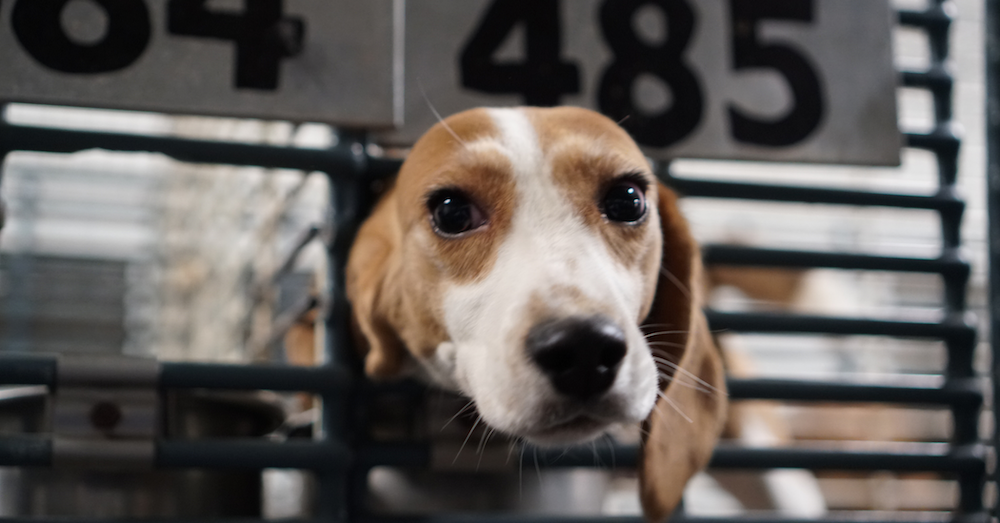
Photo: DxE
It’s been eleven weeks since Ridglan Farms agreed to wind down the breeding arm of its business, rather than face a criminal trial for felony animal cruelty. Despite the urging of animal rights groups, the agreement Special Prosecutor Gruenke negotiated with Ridglan Farms did not confiscate their 3,200 beagles; instead, it gave America’s second largest beagle breeder until July 1, 2026 to dispose of them.
Legally, beagles are property. Ridglan has sold them for “maximum pain” experiments funded by U.S. taxpayers; they can pivot them into Ridglan’s own research (that arm of Ridglan’s business is USDA compliant) or kill surplus beagles to sell their carcasses for dissection kits.
A leaked customer list showed that Ridglan’s top purchaser (NASCO Education) bought 1,022 beagle cadavers for dissection in 2019, another 714 in 2020. How did Ridglan fill enormous cadaver orders, given their modest cold storage capacity? We asked repeatedly, but Ridglan did not reply.
Dane County Supervisor, Colin Barushok, expressed concern about the fate of unsold dogs given Ridglan’s July 1st deadline:
“Without a state law requiring Ridglan to make dogs available for adoption, 3,000 beagles could be euthanized.”
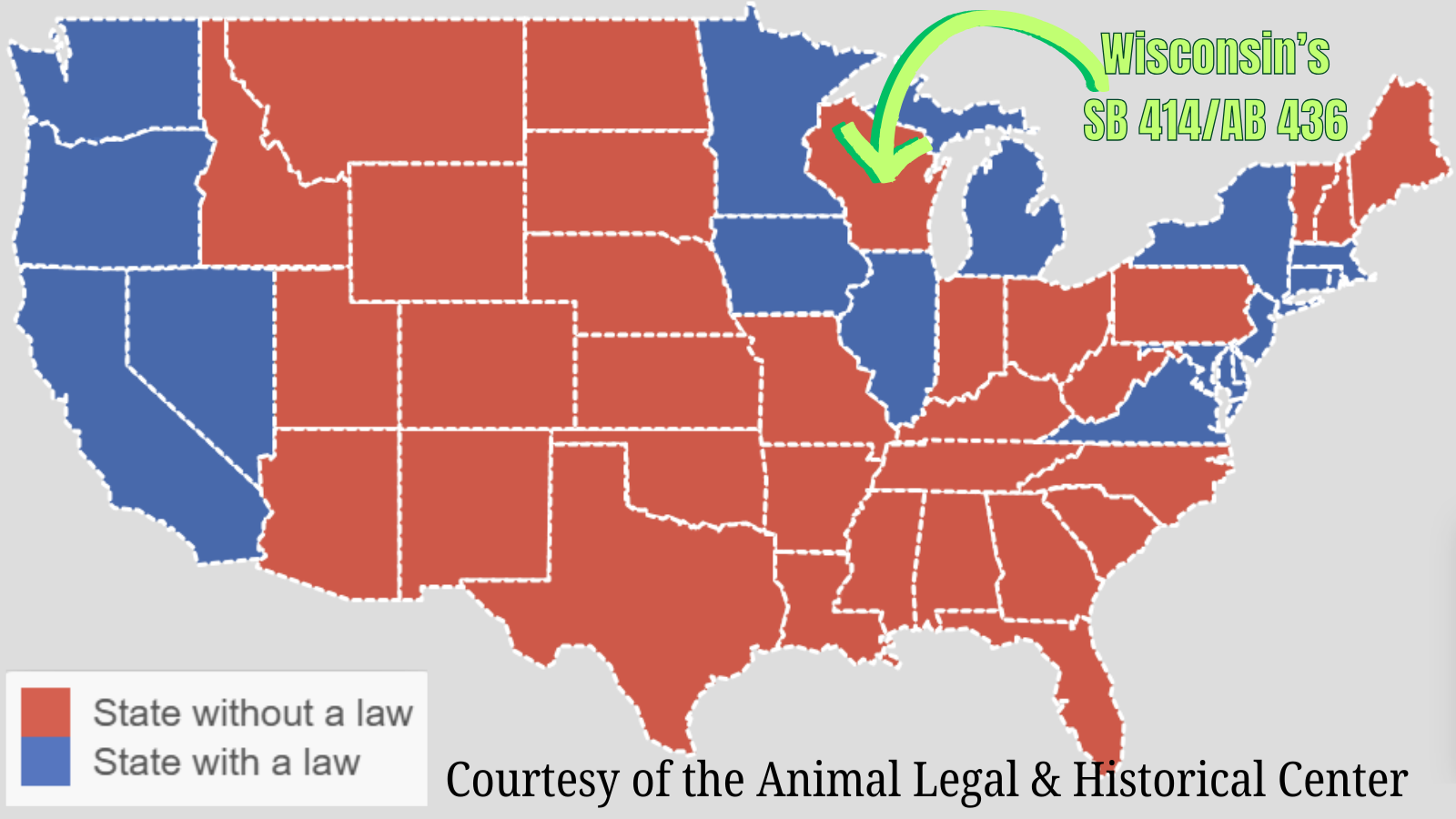
16 states already require research facilities to list healthy dogs and cats for adoption, instead of killing them once an experiment or study ends. Supervisor Barushok wants Wisconsin laboratory animals to have the same chance at being adopted into a loving home. “In my full-time job, I serve as a legislative assistant to State Senator Carpenter, so I helped draft Senate Bill 414,” he said.
Introduced as Wisconsin’s Beagle Freedom bill, S.B. 414 quickly won bipartisan support. But two months later, Senator Wanggaard submitted amendments, which critics claim eviscerated the bill’s intent.
One such critic is Wayne Pacelle of Animal Wellness Action: "The amendment gives laboratories unregulated discretion to decide if a dog/cat is “suitable” for adoption; it exempts labs from Wisconsin’s open-records laws; and eliminates penalties if labs fail to keep lists of animal test subjects."
Six organizations joined Mr. Pacelle in a letter to Wisconsin legislators, condemning Senator Wanggaard’s amendment.
We asked Senator Wanggaard who persuaded him to propose these changes? He would not name names.
If Senator Wanggaard’s amendments are adopted, the fate of dogs/cats deemed “healthy and safe” would still rest on the subjective opinion of a laboratory’s chief veterinarian. At Ridglan Farms, that chief vet was Richard Van Domelen.
Dr. Van Domelen routinely ordered at least ten Ridglan employees to sever dogs’ vocal cords, remove eye glands or (in one case) extract teeth, despite knowing they were neither veterinarians nor vet techs. Former employees Scott Gilbertson and Matthew Reich testified that the operations were done “cage-side” on squirming dogs with neither anesthesia nor post-operative pain relief.
Delegating surgeries to unlicensed staff is a prosecutable felony under Wisconsin’s §951.02 and also prohibited by Wisconsin’s Administrative Code. Ridglan’s records indicate this occurred around 500 times since 2022. Van Domelen argued the law was not applicable to research institutions like Ridglan, but he was cited and suspended by a unanimous Veterinary Examining Board.
Asked how long Van Domelen will remain suspended, DATCP’s Executive Director Mace told us: “Unless otherwise ordered by the Veterinary Examining Board, he’ll remain suspended until there is a final decision in the ongoing disciplinary proceeding against him.”
Even suspended, Van Domelen remains on Ridglan’s payroll. Who replaced him as veterinarian to assist dams in difficult pregnancies or dogs hurt in cage fights? Who removes interdigital cysts, infected teeth or inflamed eye glands now? We asked Ridglan’s newly-hired Public Relations representative, Jim Newman. He did not reply.
Is the tide turning against animal experimentation?
“Absolutely," replied Amy Van Aartsen, Executive Director of The Marty Project and a stem cell researcher using non-animal methods. “America’s Food & Drug Administration, National Institute of Health and Environmental Protection Agency all announced in early 2025 that they are seeking to replace animal testing with human relevant methodologies like organs-on-a-chip created with human cells, organoids, and AI-driven computational models."
A 2025 opinion poll found only 47% of Americans view drug testing on animals as morally acceptable; a drop from 65% in 2001. The gap is narrowing between America’s opposing political parties as more Republicans become critical of animal testing, moving them closer to Democrats.
Lindsey Soffes of Rise for Animals followed the money. Tracking Ridglan’s interstate domestic sales, she noted that Ridglan sold around 760 dogs January through June 2025. “If Ridglan follows the same sales pattern observed since 2022 (when it appears over half its annual sales were made in the first two quarters), Ridglan may sell fewer than 1,500 dogs this year.”
Beagle advocates Dane4Dogs are heartened by Ridglan’s decline in sales. In January 2025, the group began writing letters to Ridglan’s buyers, urging them to boycott Ridglan or risk public exposure. Ridglan sued, alleging “injury to business” and “tortuous interference with contractual relationships”.
“It’s nonsense,” said attorney Steffen Seitz of the Animal Activist Legal Defense Project. “Dane4Dogs letter writing campaign is protected free speech.”
Citing Supreme Court decisions of the Civil Rights era, Seitz argued that Ridglan’s lawsuit should be dismissed. If the judge agrees, it would end Ridglan’s lawsuit and the letter-writing campaign can resume.
What about the 3,200 beagles still in Ridglan?
Kindness Ranch welcomed Envigo's beagles in 2022 and stands ready to help Ridglan’s dogs. Although Executive Director, John Ramer, told us Rigdlan still “refuses to engage,” Ridglan’s beagle advocates remain determined. “We’re not giving up,” they all agreed.
How you can help:
International readers can email Wisconsin’s Congressman Mark Pocan at mark.pocan@mail.house.gov.
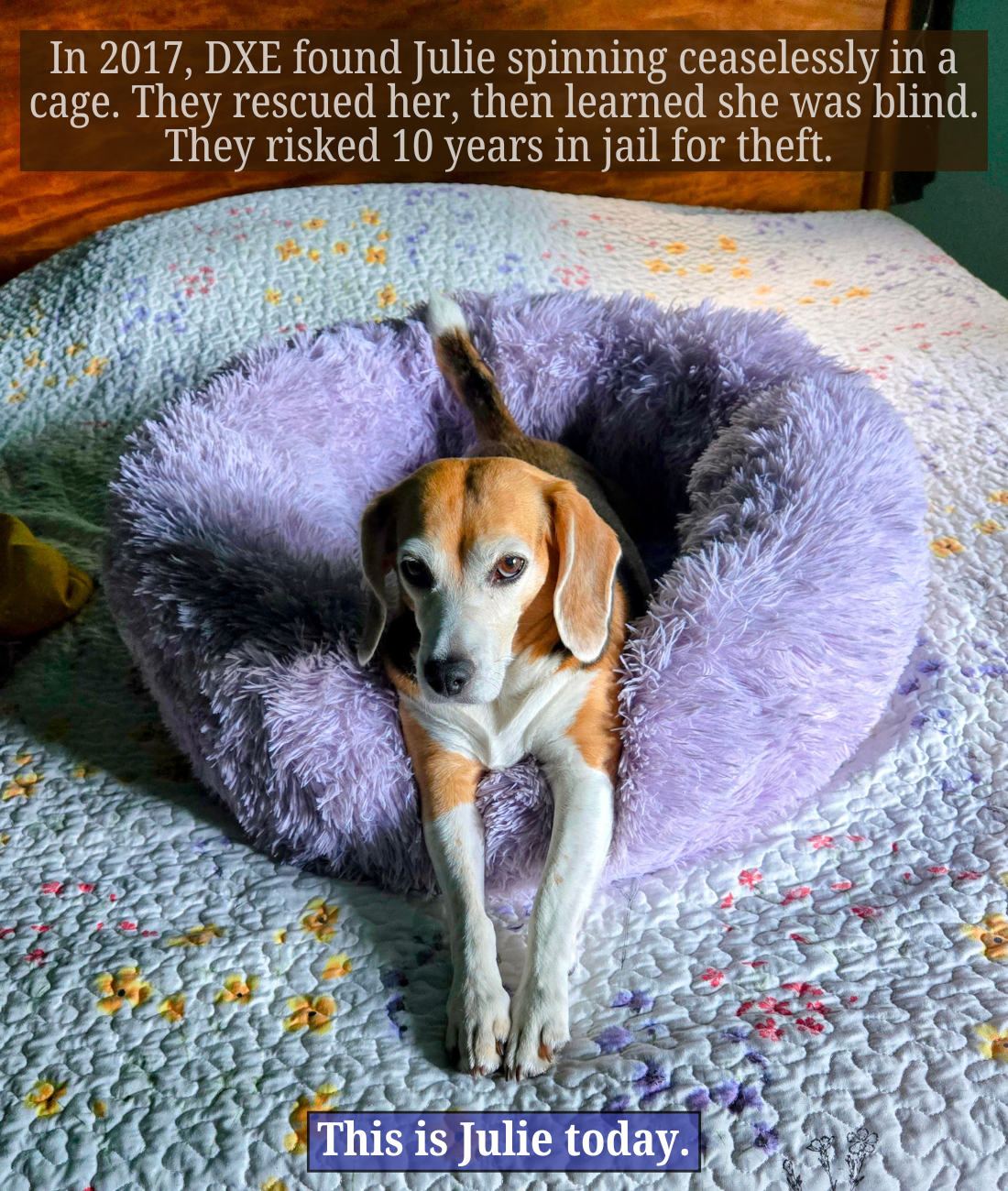
Forward him our image of Julie (first pic in article) and politely urge Rep. Pocan to advocate for other beagles still caged in Ridglan. Julie should not be the last Ridglan beagle to ever find a loving home.
U.S. readers should phone (202) 225-2906 Wisconsin’s Congressman Mark Pocan (WI-02). Politely remind Rep. Pocan that, as a member of the Congressional Animal Protection Caucus, he should adhere to principles of compassion and urge Ridglan to do the right thing, namely, adopt out their 3,200 “surplus” breeding beagles. Kindness Ranch is ready to take them.
Wisconsinites should call or email Wisconsin state representatives (find your legislator here). Tell them you support Wisconsin’s Beagle Freedom bill (A.B.436/S.B. 414) as originally written, but not its subsequent amendments.
Learn more about Wayne Hsiung’s plan to save the Ridglan Dogs here.
We Have A Favor To Ask…
Species Unite amplifies well-researched solutions to some of the most abusive animal industries operating today.
At this crucial moment, with worldwide momentum for change building, it’s vital we share these animal-free solutions with the world - and we need your help.
We’re a nonprofit, and so to keep sharing these solutions, we’re relying on you - with your support, we can continue our essential work in growing a powerful community of animal advocates this year.
More stories:
A former president and conservationists have criticized Botswana’s decision to kill 23 elephants for meat as part of its 60th independence celebrations.