
Hungary bans wild animals in the circus ring from 2027
Effective from January 2027, the new laws reflect strong societal expectations that animals do not belong in the circus, said the Hungarian government.
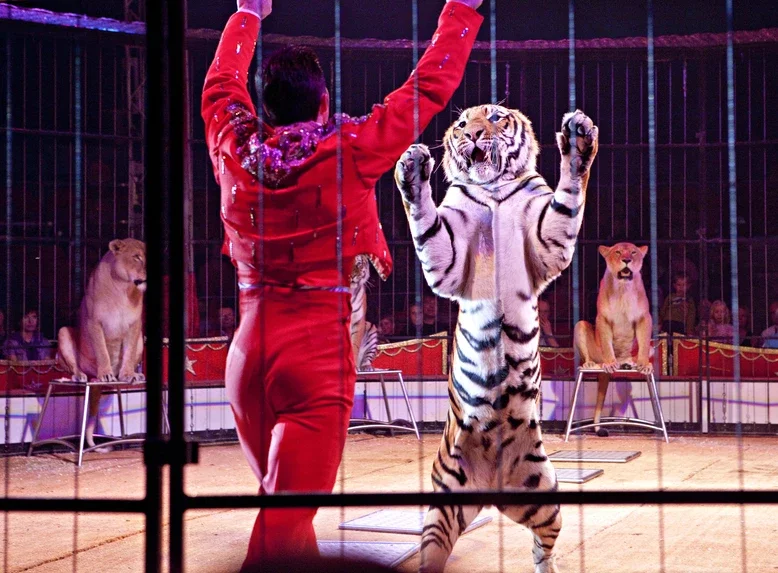
A big cat performance inside a traveling circus ring in Europe. Credit: FOUR PAWS/Fred Dott
Hungary has banned the use of wild animals in circuses, making it the latest European country to end the practice under a new government decree that takes effect on January 1, 2027.
Under Government Decree 124/2026, published in the Hungarian Gazette on August 13, a broad range of species will no longer be acquired, bred, kept, trained, or forced to perform in circuses.
The definition of wild animals has also been extended under the new legislation, which previously applied only to elephants, rhinoceroses, and primates. The ban now covers 25 distinct animal groups, including giraffes, kangaroos, seals, big cats, and birds of prey, as well as hybrids up to the fourth generation. Domestic animals, including dogs, cats, horses, donkeys, and pigs, remain exempt. Wild animals already in circuses may live out their natural lives at their current locations, but may no longer perform.
"This ban marks a long-awaited step forward for animal welfare in Hungary," said Raul Vida, CEO of Empathy Story and Forbes 30 Under 30 Animal Advocate. "It reflects decades of work by advocates, organizations, and partners who kept this issue on the public and political agenda."
A government spokesperson said that using wild animals in the circus is “incompatible” with modern standards, and that such legislation would bring Hungary in line with other European Union member states. According to data from Eurogroup for Animals, 24 out of 27 EU member states now maintain national restrictions on animal circus acts.
With the exception of Germany, the use of animals in circuses has been partially or entirely banned in Europe. Austria was the first European country to impose a nationwide ban on wild animals in circuses, back in 2005. In 2012, Greece became the first country to prohibit any animal from performing in a circus.
Local bans exist in Germany, but the government has so far resisted calls for a nationwide law. In Russia, China, Thailand, and across all of Africa, there are currently no laws in place to protect animals from performing in circuses.
In the U.S., over 150 cities and counties across 37 states have restricted or banned the use of wild animals in circuses and traveling shows. New Jersey became the first state to introduce a ban on traveling wild animal acts, in 2018.
This historic legislation was named Nosey’s Law, after an African elephant who had been exploited by an Orlando-based traveling circus to such an extent that she was suffering from skin infections, intestinal parasites, osteoarthritis, dehydration, and malnutrition. Following a 14-year campaign led by PETA to secure her freedom, a Lawrence County district judge ruled that Nosey should not be returned to the circus, clearing the way for her transfer to an elephant sanctuary in Tennessee.
Since then, California has taken the strongest stance of any U.S. state, in banning the use of all animals (except dogs and cats) in circuses, as part of the Circus Cruelty Prevention Act, passed in 2019.
In other states, bans apply only to certain animals. Illinois, for example, has a statewide ban that applies exclusively to elephants.
The issue of wild animals in circuses came into sharp focus earlier this year, after a leading elephant expert expressed “significant cause for concern” for the psychological and physical wellbeing of Viola, dubbed the world’s most desperate elephant, having attempted on four separate occasions to escape her life in a traveling circus.
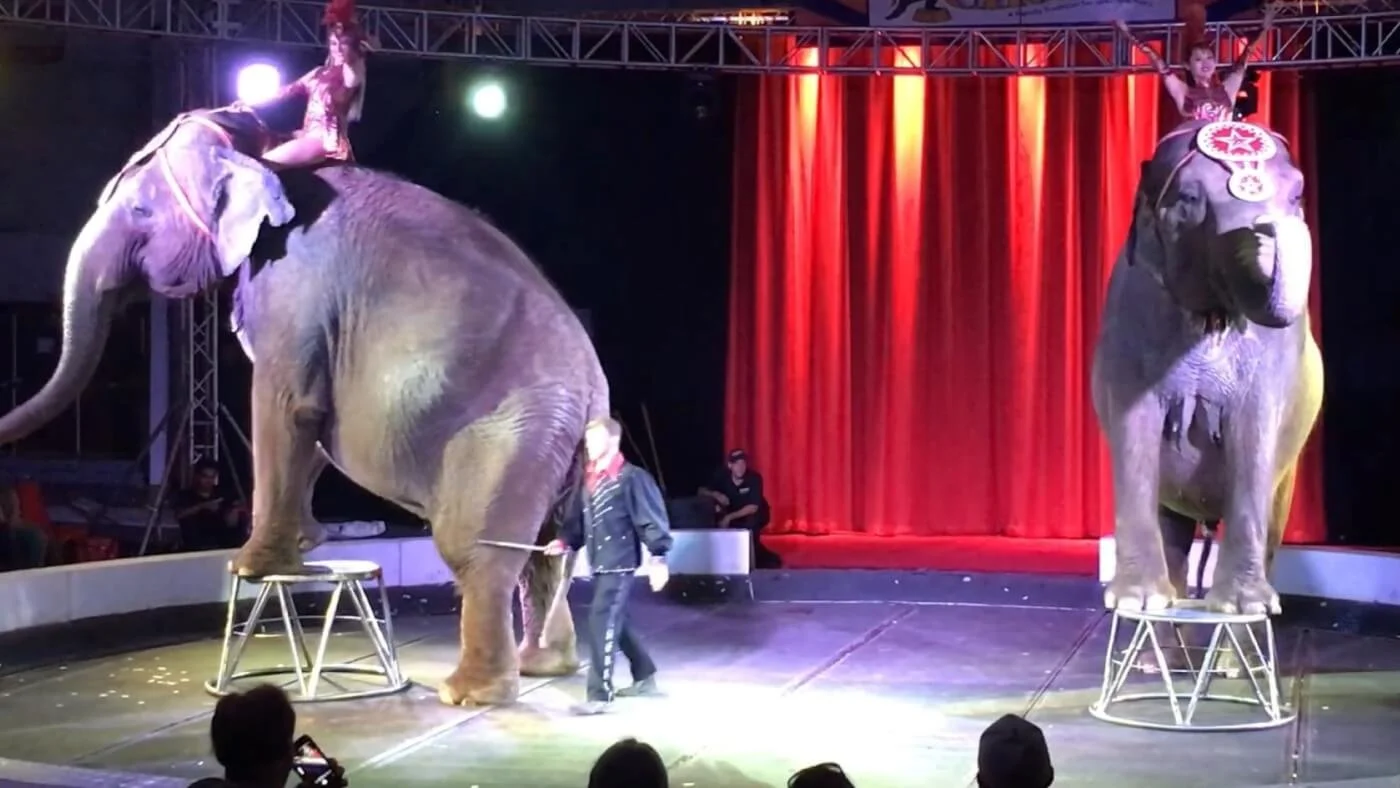
Viola and another elderly elephant Isa, pictured here in a performance during a circus tour in 2018, are typically on the road for many months each year, often in a different city every day or two. In 2025, Viola was forced to perform at roughly 200 shows and spent most of the year on the road. Credit: PETA
While circuses and traveling shows in the U.S. are regulated by the Animal Welfare Act (AWA), campaigners say this only establishes minimal standards of care for licensees in terms of housing, sanitation, and food.
When licensees are found to have violated the AWA, which permits the use of bullhooks, electrical shocks, and whips, inspectors typically issue verbal warnings or negligible fines.
Viola’s owner, Carson & Barnes, has been cited for repeated violations of the AWA, dating back to 1975. Its biggest fine was $16,000, when three elephants escaped from a circus performance and ran amok, injuring themselves and damaging property.
Take the 30 Days of Action for Animals challenge: This August, we're challenging you to take one action for animals every single day. From signing petitions and contacting lawmakers to making different choices at the dinner table, every action adds up. Sign up now to get your first action from tomorrow.
With animal stories making up less than 2% of the news cycle, we're here to fill that gap. Sign up for Species Unite’s weekly news digest.
The animals need a newsroom in their corner
Every week we dig into the animal stories the mainstream news overlooks. Investigations, exposés, legal battles, and victories - none of it happens without your support. A monthly gift of as little as $5 keeps us covering the 98% of animal news the world isn't seeing.
More stories:
Significant investment and revised regulations across four government agencies are part of an ongoing effort to support innovative scientific research ahead of “outdated” testing on animals.