
Another horse dead: Central Park tragedy intensifies fight over carriage ban
“I’m angry. I’m frustrated. We must stop this industry. Now.” declared New York Councilman Harvey Epstein, reacting to news that Deniz, a spotted draft horse, collapsed and died in Central Park Tuesday evening.
Deniz, who allegedly passed his veterinary exam in March, was pulling two tourists and 52-year old driver Nurettin Kirbiyik around Central Park’s upper west side on June 9, when he began shaking and collapsed, Kirbiyik said.
Cell phone videos from the scene show good Samaritans removing the prone horse’s carriage shaft and unbuckling his harness as he gasped and jerked his right foreleg. A witness said Deniz suffered for ten minutes before dying.
Danielle Leean Chin was also in Central Park walking her dog when she came upon the dying horse on West Side drive. “This is the second incident that I've seen in ten months," Chin said.
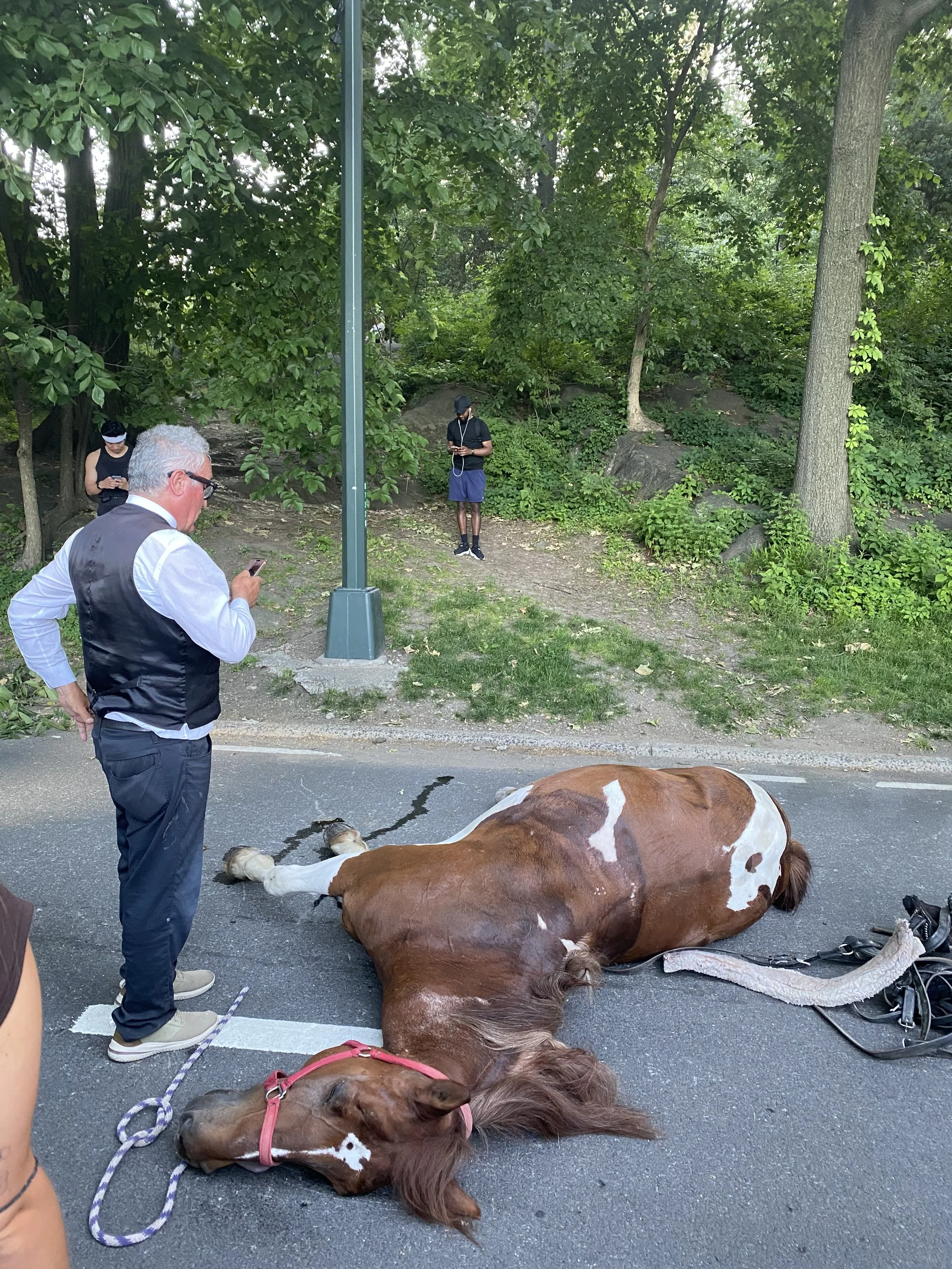
Credit: Ashley Bryne/PETA
The Central Park Conservancy (CPC), which manages the 843-acre park and sees 42 million visitors annually, reiterating its May 19 position (when a carriage driver toppled to the ground) that “it’s time to end this practice.”
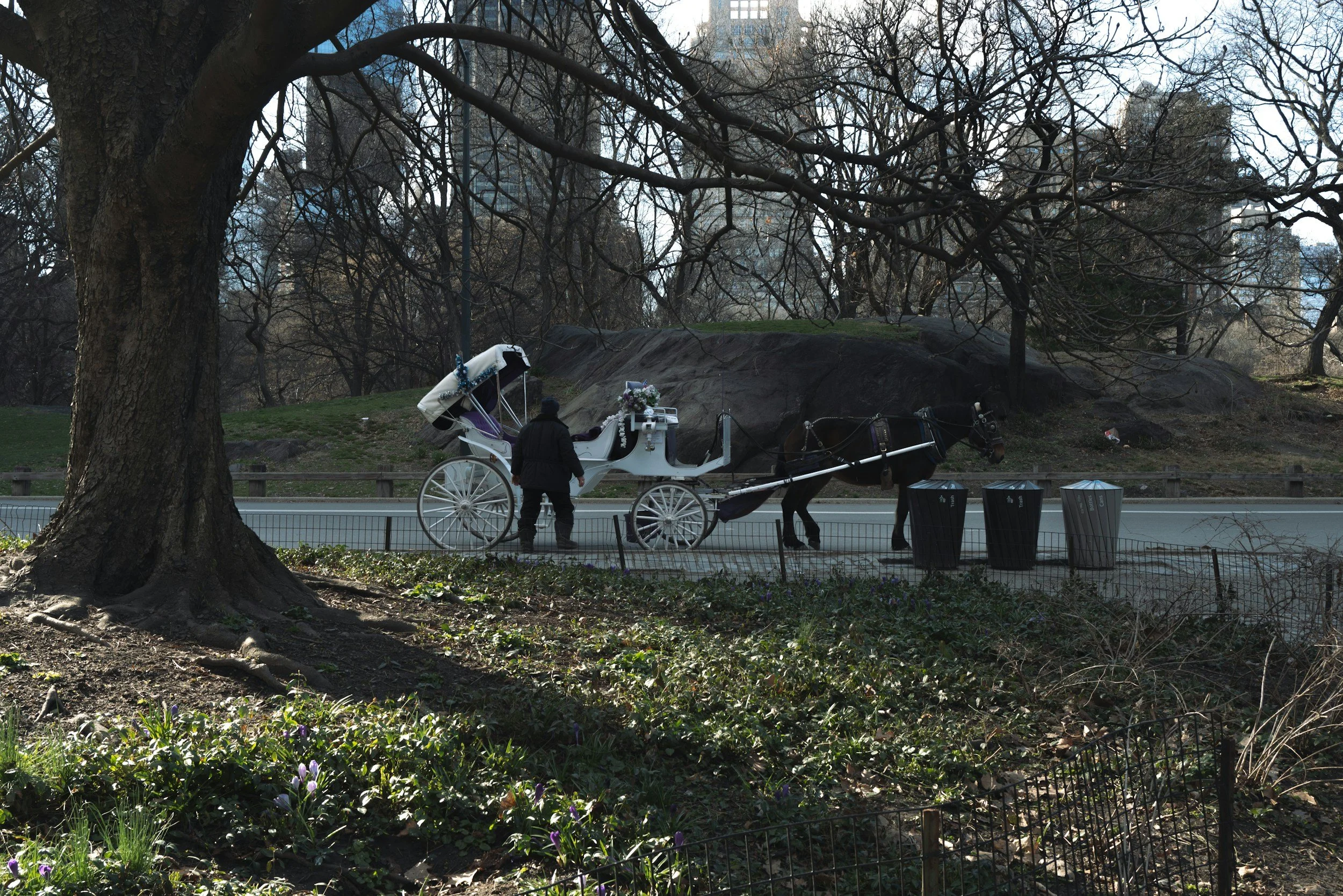
The park’s stance is weighty because carriage horses are only allowed to board passengers on “hack lines” inside Central Park, according to a 2018 regulation promulgated by former Mayor DeBlasio and intended to minimize the horses’ exposure to car fumes and city traffic. Carriage horse drivers challenged the new rule, lost in court, yet a few still expose horses to congested tourist sites like Times Square for better tips.
Tourists, who comprise 85-90 percent of carriage horse customers, choose between short and long loops within Central Park. Despite these precautions, horse-related incidents persist: CPC listed seven in the past 13 months.
“New Yorkers are tired of witnessing horses running into traffic, getting injured, collapsing and dying,” concluded Councilman Carl Wilson whose district includes both West Side Livery (built in 1906) and Clinton Park Stables (built in the 1880s) where NYC carriage horses overnight.
But despite the spate of accidents and the creation of an Animal Welfare Caucus in March 2026, council members of that caucus had not yet re-introduced a bill to ban horse drawn carriages by the time Deniz collapsed and died.
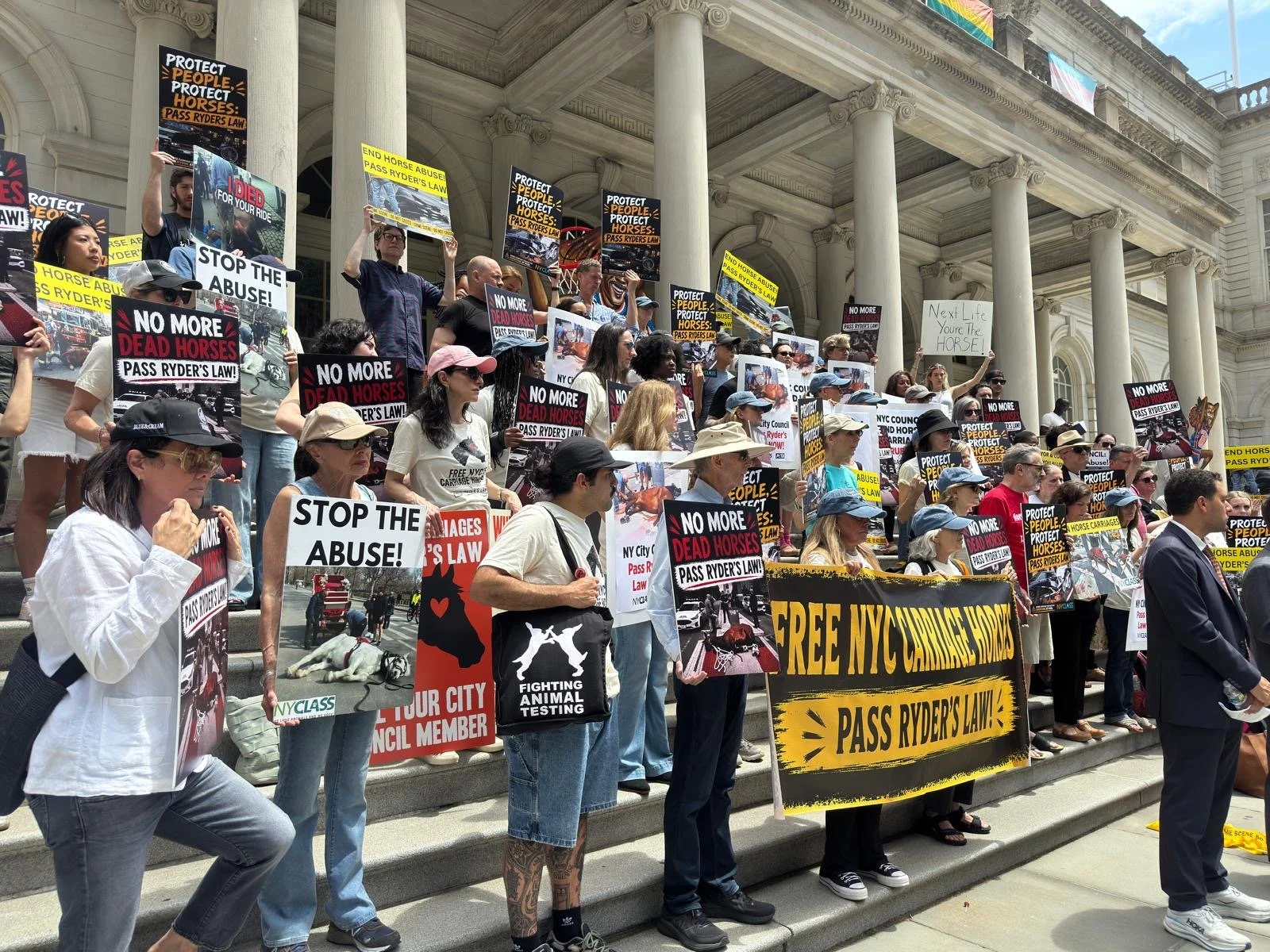
The morning after Deniz’ death, over 90 activists began gathering on the steps of New York’s City Hall, battle-hardened and determined to urge the 51-member City Council to re-introduce Ryder’s Law-- a bill named after a thin, 26-year old Standardbred who collapsed on 9th Avenue and whose driver, Ian McKeever, was the first ever to stand trial for overdriving a horse.
Among Wednesday’s assembled activists was Donny Moss, director of the 2006 documentary Blinders who hopes “City Council Members reintroduce and pass Ryder’s Law and that Speaker Menin and Mayor Mamdani allow democracy to run its course.”
Wildlife rehabilitator P.J. McKosky, who’s been protesting for 20 years, was hopeful, too.
In a press conference Mayor Mamdani said he was “disturbed by what (he) saw” and “supports removing horse carriages from Central Park.” He then said he “look(s) forward to working with union partners and community leaders to actually deliver on that."
It may be a difficult negotiation for New York’s democratic-socialist mayor, since the Transit Workers Union (representing not just the ~170 individuals who comprise the carriage horse industry, but 42,000 blue collar transit workers) and Central Park Conservancy (founded by affluent Manhattanites in 1980) want opposing outcomes.
This tension between a full carriage horse ban versus additional corrective regulations is reflected in the pair of bills introduced to City Council on June 11.
Dueling bills
Ryder’s Law 3.0 (#Int 0943-2026) was re-introduced to the council Thursday afternoon, by councilman Chris Marte, the bill’s primary sponsor. It has the momentum of two prior attempts and the support of nine other council members already-- including republican Frank Morano.
Councilman Morano pointedly warned that although there haven’t yet been any human deaths, “What happens next time? Eventually luck runs out.”
#Int 0943’s major features include a two-year phase out followed by a complete ban on carriage rides by June 2028; a prohibition on horses being sold/transferred to slaughter or to another horse drawn cab business; and a requirement that NY’s Dept. of Consumer and Worker Protection facilitate job training for carriage horse employees (many of whom are immigrants) into other fields.
But Marte’s was not the only bill addressing carriage horses on June 11.
Councilman James Gennaro of Queens proposed a countermeasure (#Int 0937-2026) that would preserve the industry, but address specific concerns: e.g. add new hitching posts within Central Park, rely exclusively on the National Weather Service for heat alerts, and establish criteria for examinations and probationary licenses for carriage horse drivers. Gennaro’s bill would also create a five-person Advisory Board to make further safety recommendations and allow horse-drawn carriages to begin as early as 7:00A.M.
New hitching posts, a 7:00AM start time and an updated drivers’ exam were all elements in the Transit Workers Union Big HEART platform, developed months ago to protect approx ~170 carriage horse owners, owner-drivers and drivers whom the union began representing after a seven-month COVID lockdown nearly killed the industry.
Now, it falls to the New York City council members to decide whether political pressure outweighs what everyone — New Yorkers, conservancy officials, activists, and the mayor — can plainly see.
Take action now: We can help end the suffering of these horses. Join Species Unite in urging New York City Council Members to do the right thing by finally passing Ryder’s Law and giving these horses the lives they deserve.

Written by Tamara Bedić, Esq.
Tamara Bedić, Esq. is a New York attorney, championing women in the workplace. When she's not litigating, she is rescuing injured birds, chairing the Animal Rights Committee of the National Lawyers Guild or walking her special needs cat, ILLYA.
We Have A Favor To Ask…
Species Unite amplifies well-researched solutions to some of the most abusive animal industries operating today.
At this crucial moment, with worldwide momentum for change building, it’s vital we share these animal-free solutions with the world - and we need your help.
We’re a nonprofit, and so to keep sharing these solutions, we’re relying on you - with your support, we can continue our essential work in growing a powerful community of animal advocates this year.

A cleaner New York Harbor has drawn hundreds of humpback whales back to its waters for the first time in generations, but the same busy port that welcomes them is also killing them.