
River otter returns to the Bronx River after more than 100 years
The “incredible” sighting signifies that the Bronx River, once among America’s most polluted and neglected urban waterways, is now enjoying a healthy ecosystem following decades of restoration efforts
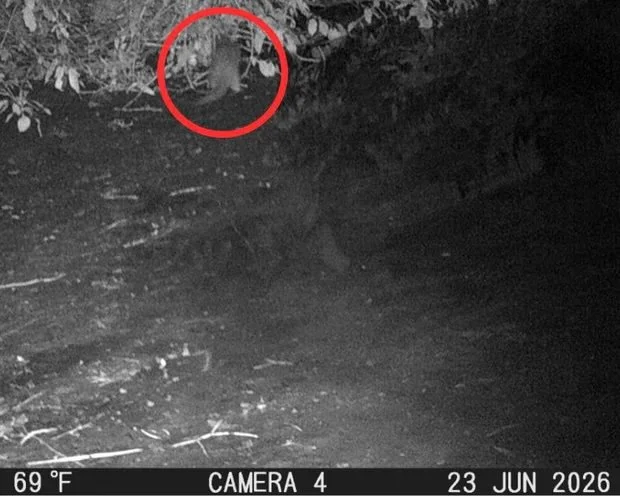
A North American river otter (Lontra canadensis) in the Bronx River. Credit: RJ Hawkins/Wildlife Conservation Society Education Dept
Conservationists are celebrating after a North American river otter (Lontra canadensis) was spotted in the Bronx River for the first time in more than 100 years.
Captured on a motion-activated camera set up by local scientist RJ Hawkins, the June 23 footage is believed to be the first documented sighting of an otter in the Bronx section of the river since the early 1900s.
"When I first reviewed the images, I could hardly believe what I was seeing," said Hawkins, whose work is overseen by the Wildlife Conservation Society’s Education Department based at the Bronx Zoo. "Knowing this may be the first documented rivåer otter in the Bronx in generations was an incredible moment."
Once a familiar sight along the waterways of New York, river otter populations plummeted during the mid-20th century, as a result of pollution, habitat loss, and unregulated trapping for fur. The Bronx River quickly became one of the most polluted, as it was used as an open sewer for factories and slaughterhouses to dump chemicals, animal blood, and oil. There was also regular runoff from industrial stormwater, while members of the public disposed of unwanted items. All of this had a catastrophic impact on the river’s wildlife.
Since then, the federal Clean Water Act of 1972 has prohibited industrial facilities from releasing unacceptable levels of pollution into public waterways. And dozens of nonprofit organizations and community-based projects have been set up specifically to clean and restore the Bronx River, while Eliot Spitzer announced a raft of major settlements with cities and facilities to reduce pollution, during his time as Attorney General of New York (1999–2006). These included a settlement with the Bronx Zoo, to halt its daily discharge of over 200,000 gallons of animal waste into the river, and with the New York Botanical Garden, which discharged as much as 5,000 gallons of pollution from its greenhouses every day. As Governor of New York, Spitzer settled with seven Westchester County cities and towns to reduce pollution into the river. That same year – 2007 – beavers were sighted in the Bronx River for the first time in more than 200 years.
The recent sighting of a river otter in the Bronx represents a win not only for conservation but for the river itself, as river otters need clean water, an abundance of fish, and intact habitat. The only freshwater river in New York City, the Bronx River now appears to be recovering from decades of neglect.
"This isn't simply the story of one animal – it's the story of an urban river coming back to life," said Craig Piper, director of the Bronx Zoo. "Every improvement in water quality, every acre of restored habitat, every community volunteer who has cared for this river has helped make a moment like this possible. We hope it's the first of many."

A North American River Otter swimming in Lake Nummy. Credit: Chuck Homler/FocusOnWildlife.Me , CC BY-SA 4.0, via Wikimedia Commons
Efforts to reintroduce river otters to parts of New York began in 1995, when the New York State Department of Environmental Conservation undertook a six-year program in which licensed trappers caught 279 otters from strongholds in the Adirondacks and other parts of northern New York, and gradually released them in 16 different sites across western and metropolitan areas. Populations have since flourished, especially in western New York. The North American river otter is now the only otter species classified as stable in population, and of ‘Least Concern’ on the IUCN Red List. The other 12 species of otter are all deemed either Endangered, Near Threatened, or Vulnerable.
However, amid the celebrations, some are voicing concern that New York state still permits the trapping and killing of river otters. State wildlife data reveals that over 900 river otters are killed every year, mostly for recreational purposes by a small minority of trappers. These traps are designed to crush, hold, drown, or kill by force.
“It was this same unregulated trapping that nearly eliminated otters from New York in the first place,” said McKosky, a New York-based wildlife rehabilitator. “We shouldn’t celebrate a species’ recovery in the Bronx with one hand while permitting its violent killing elsewhere in the state with the other.”
Take the 30 Days of Action for Animals challenge: This August, we're challenging you to take one action for animals every single day. From signing petitions and contacting lawmakers to making different choices at the dinner table, every action adds up. Sign up now to get your first action from tomorrow.
With animal stories making up less than 2% of the news cycle, we're here to fill that gap. Sign up for Species Unite’s weekly news digest.
The animals need a newsroom in their corner
Every week we dig into the animal stories the mainstream news overlooks. Investigations, exposés, legal battles, and victories - none of it happens without your support. A monthly gift of as little as $5 keeps us covering the 98% of animal news the world isn't seeing.
More stories:
A former president and conservationists have criticized Botswana’s decision to kill 23 elephants for meat as part of its 60th independence celebrations.