
Hawaiʻi becomes the third state in the nation where the highest court will hear a case on behalf of captive elephants
A petition on lawful imprisonment by the Non Human Rights Project is attempting to free two elephants suffering at Honolulu Zoo.
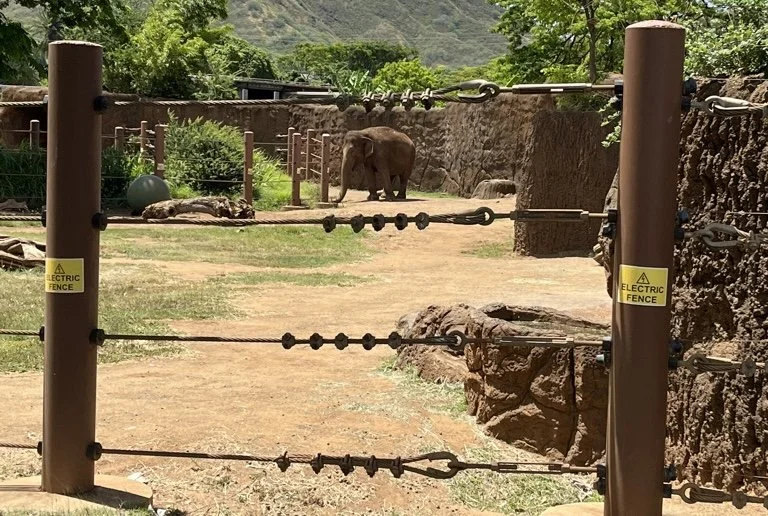
Credit: Non Human Rights Project
A lawsuit in the Hawaiʻi Supreme Court will determine the fate of Mari and Vaigai, two Indian-born female elephants who have been living at Honolulu Zoo for over 30 years.
This marks only the third time in U.S. history that a state high court has agreed to hear arguments on behalf of a nonhuman animal’s right to liberty.
The advocacy organization Nonhuman Rights Project (NhRP), dedicated to securing legal riinghts for animals, has presented a habeas corpus petition on behalf of Mari and Vaigai.
Habeas corpus is a common law right that protects against unlawful and indefinite imprisonment. In this case, the NhRP is seeking recognition of Mari and Vaigai’s fundamental right to bodily liberty and their transfer to an elephant sanctuary.
The petition was dismissed by the Hawaiʻi Intermediate Court of Appeals, and the NhRP has now asked the Supreme Court to overturn that decision and allow the case to proceed.
“As a human, you were born with an inalienable right to liberty, and we are trying to extend that right to the elephants and effectively have them relocated from the Honolulu Zoo to an elephant sanctuary,” says Jake Davis, senior staff attorney with the NhRP.
He added that the idea isn’t for elephants to possess all the rights that humans have. “All we are asking the court to recognize is the elephants’ single right to liberty. What that would do is give them the opportunity to live as nature intended elephants to live.”
Both elephants were torn away from their families in the wild and brought to the zoo as a gift from the Indian government in the 1980s and 1990s.
They have since been used in promotional gimmicks (such as sports game predictions) and zookeeper demonstrations. In some of these demonstrations, the elephants can be seen exhibiting signs of zoochosis - a condition brought on by the stress of captivity - such as swaying and pacing, behaviours that do not occur in animals living freely in the wild.
The zoo has also been seen using bullhooks, a tool used to control animals through the threat of pain.
The NhRP’s arguments are that elephants are highly intelligent and capable of lifelong bonds as well as deep emotions. Their aim is for Mari and Vaigai to be relocated to an accredited elephant sanctuary.
In a similar case in 2022, the highest court in New York denied legal personhood to Happy, an elephant living at the Bronx Zoo. This, too, was a lawsuit filed by the NhRP.
In a story for the Atlantic, Jill Lepore called Happy’s case, “the most important animal-rights case of the 21st Century.”
The Hawaiʻi Supreme Court has not yet scheduled a date to hear oral arguments, but should this petition be successful, it could have major implications for animal rights.
Species Unite is examining elephant captivity in the United States and the growing movement to change the system. Our upcoming documentary follows the legal challenges brought by the Nonhuman Rights Project to secure the release of elephants held at zoos. Help us bring this film to life here.
Listen to the Species Unite podcast episode with NhRP’s late founder, Steven Wise, here.
We Have A Favor To Ask…
Species Unite amplifies well-researched solutions to some of the most abusive animal industries operating today.
At this crucial moment, with worldwide momentum for change building, it’s vital we share these animal-free solutions with the world - and we need your help.
We’re a nonprofit, and so to keep sharing these solutions, we’re relying on you - with your support, we can continue our essential work in growing a powerful community of animal advocates this year.

As opposition to octopus farming grows worldwide, Colombia is moving to ban the practice before a single farm is built.