
Four litters boost critically endangered red wolf population
As many as 16 red wolf pups are said to be doing well in the wild of North Carolina, as the species looks to fight back once more from extinction.
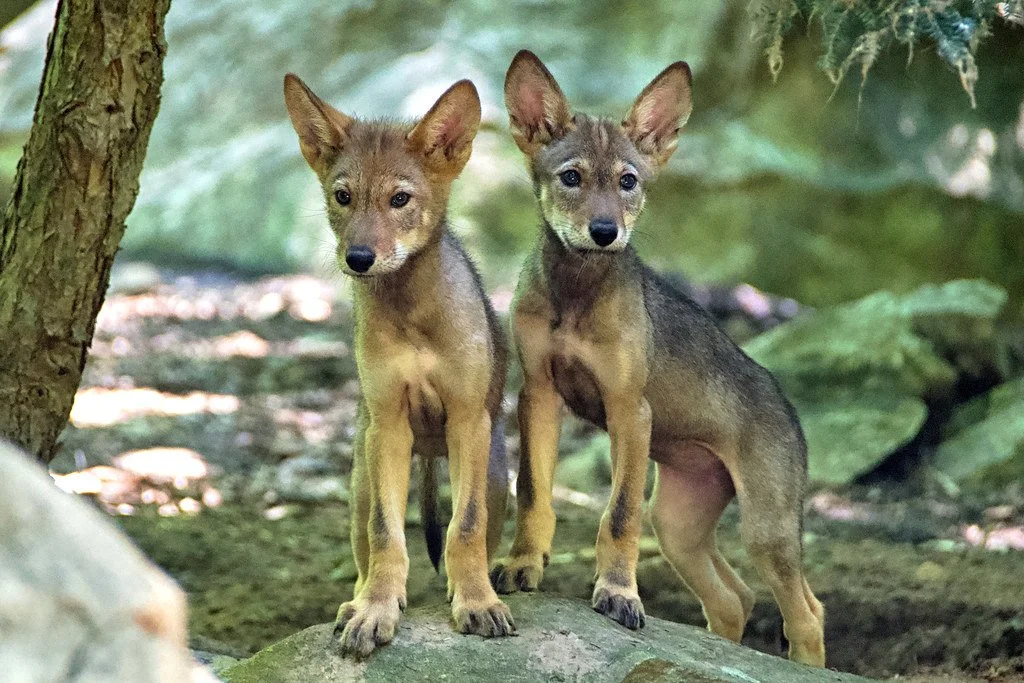
Credit: “Red wolf pups (Canis rufus)” by ucumari photography, CC BY-NC-ND 2.0
Conservationists are celebrating the news that up to 16 red wolf pups have survived their first few months in the wild, after four litters were born earlier this year.
These are the highest numbers recorded in several years, according to the U.S. Fish and Wildlife Service’s (FWS) Red Wolf Recovery Program.
Officials hand-captured the pups shortly after they were born, and administered vaccines before fitting them with abdominal transmitters to help track their health and development.
As of July, at least six mortalities have been recorded. The natural pup survival rate of red wolves in the wild is 50 percent, with mortality most likely occurring within the first few months. Given that all four litters were born in early or mid April, conservationists are cautiously optimistic.
FWS says the surviving pups all appear to be "doing well," and the latest findings suggest at least 12 pups remain in the wild. Another four do not have transmitters, and so the number could stand at as many as 16.
This development is significant, as the species is listed as Critically Endangered on the IUCN Red List, with just 22 adult red wolves currently living in the wild.
The red wolf has already been declared extinct, as recently as 1980, having lost 99.7 percent of its historical territory, which once spanned Texas, Florida, and the Midwest. But a pioneering program saw captive-bred red wolves released annually into the wild of eastern North Carolina from 1987 onwards.
As the wolves established territories, formed packs, and bred successfully, numbers increased. This was the first time in the U.S. that a large carnivore had been declared extinct in the wild and then reintroduced.
However, after reaching a peak of 120 red wolves in 2012, the population plummeted dramatically. By 2020, just seven wild red wolves remained.
Vehicle collisions are the main cause of death for North Carolina’s red wolves, who live in or around the Alligator River National Wildlife Refuge, and the Pocosin Lakes National Wildlife Refuge, both of which are on U.S. Route 64.
It is for this reason that private landowners have been encouraged to allow the release of red wolves onto their land, through education and incentives.
For example, the Prey for the Pack program – a collaboration between FWS and the North Carolina Wildlife Federation – rewards landowners who maintain healthy habitats for prey species like deer and rabbits, so that red wolves have access to sustainable food sources.
Two of the four litters were born on private land - a sign that such efforts are working.
In a further boost, North Carolina has received a $31 million federal grant to build wildlife crossings along major highways, including Route 64, on which hundreds of wild animals are killed every year.
Species Unite's Wolves in School program brings the story of wolves into classrooms across the country through storytelling, science-based materials, and a call to action for young people. Free and downloadable for grades 3–12. Sign up here to download your free digital Wolf Education Guide.
Species Unite News is a weekly round-up of the most important animal stories happening around the world. Join over 250,000 others who start their week with the latest animal stories delivered straight to their inbox.
We Have A Favor To Ask…
Species Unite amplifies well-researched solutions to some of the most abusive animal industries operating today.
At this crucial moment, with worldwide momentum for change building, it’s vital we share these animal-free solutions with the world - and we need your help.
We’re a nonprofit, and so to keep sharing these solutions, we’re relying on you - with your support, we can continue our essential work in growing a powerful community of animal advocates this year.
More stories:
Pronghorn have used the overpass to cross Interstate 25 safely for the first time in 30 years, while bears, coyotes, deer, elk, moose, frogs, and a threatened species of mouse have also been taking advantage of the $15 million crossing.