
Two Sumatran rhinos are pregnant, says Indonesian sanctuary, in a huge boost for the critically endangered species
Breeding programs have often fared badly, but the Sumatran Rhino Sanctuary – home to the only captive population of Sumatran rhinos in the world – continues to set new records.
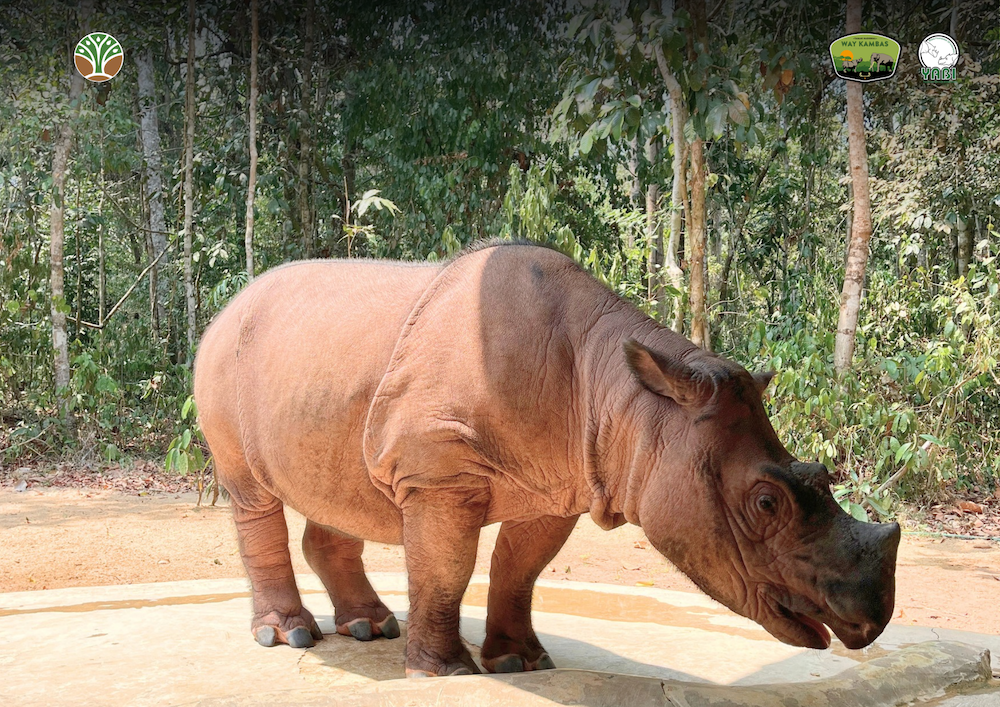
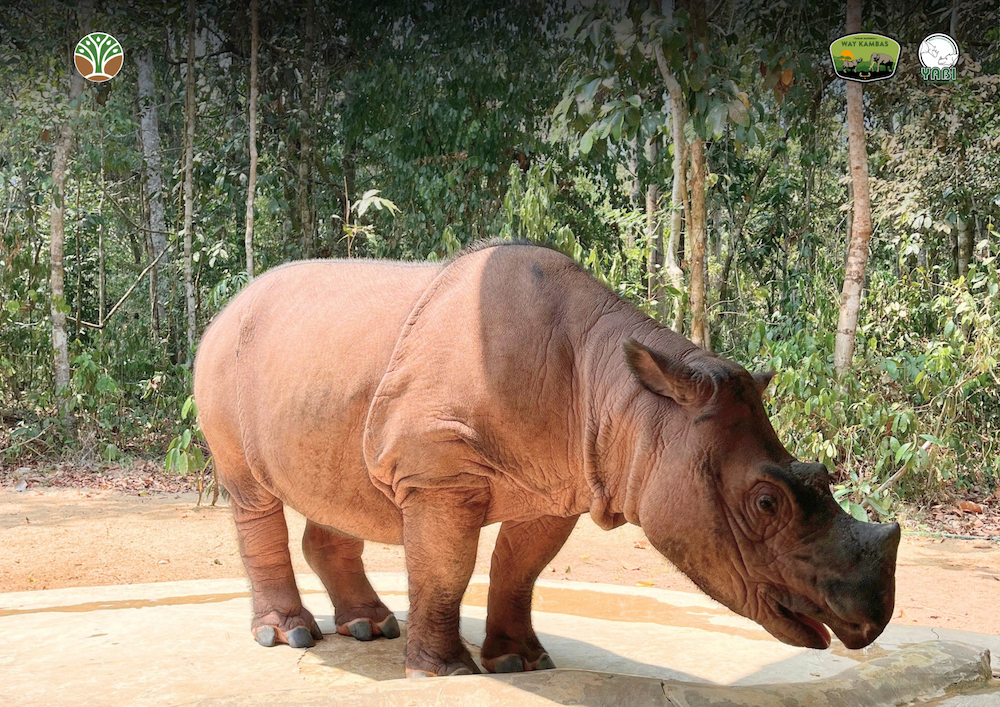
Delilah, a Sumatran rhino (Dicerorhinus sumatrensis) born at the sanctuary, is pregnant with her second calf. Credit: Courtesy of the Indonesian Ministry of Forestry.
Two Sumatran rhinos are pregnant at a sanctuary in Indonesia, according to the facility, in a huge boost for a species that is not only critically endangered but that has difficulty with reproduction.
The Sumatran Rhino Sanctuary (SRS) in Way Kambas National Park confirmed that Ratu is pregnant with her fourth calf, with a gestation age of approximately 7.9 months, and that Delilah is pregnant with her second calf, with a gestation age of approximately 8.3 months. The gestation cycle lasts 15 months, and calves remain dependent on their mothers for up to two years.
To date, five Sumatran rhinos have been born at SRS between 2012 and 2023. Ratu was the first to give birth, and she is now on course to become the first known Sumatran rhino to give birth to four calves.
This is remarkable, given that Sumatran rhinos have difficulty breeding. In fact, SRS had to wait 17 years for its first calf to arrive, having opened as a semi-wild breeding program in 1996. This particular species favours a solitary lifestyle, with very little interest in companionship, let alone romance. In addition, according to Dr. John Payne of the Borneo Rhino Alliance, females tend to suffer from tumors and cysts in their reproductive tract if they do not produce babies once becoming sexually active.
Any successful pregnancy is a significant milestone in Sumatran rhino conservation, especially as numbers continue to plummet. Classified as Critically Endangered on the IUCN Red List, the population of Sumatran rhinos has dropped to as low as 34, down from more than 300, in 2005.
Efforts to breed Sumatran rhinos in captivity have been ongoing since the early 1990s, when 17 wild-caught rhinos were dispersed to zoos in the U.S. and Britain, and to sanctuaries in Indonesia and Malaysia. Most of these rhinos succumbed to disease and illness, and by 2007, only four were still alive – two in SRS, and two in Cincinnati Zoo.
At this time, only Cincinnati had seen any successful pregnancies, after Ipuh – who had been at the zoo since 1991 – mated with a young female named Emi, who gave birth to Andalas, in 2001. This was the first time that a Sumatran rhino had been bred in captivity since 1889. Andalas was transferred to SRS in 2007, in the hope that he would mate.
In 2012, Andalas fathered a son, Andatu, with Ratu. It was only the fourth recorded case of a Sumatran rhino being born in captivity in over a century, and the first rhino birth in captivity in Indonesia in 124 years. Andalas went on to father a female calf with Ratu, in 2016. They welcomed their third calf – a female – in 2023.
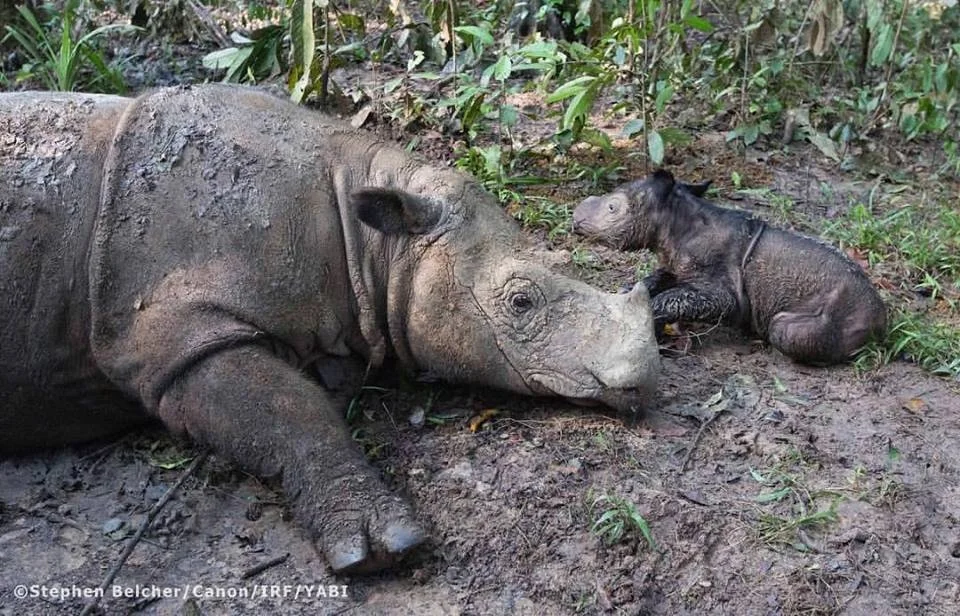
Ratu with her first calf Delilah, who she gave birth to in 2016. Image courtesy of the International Rhino Foundation
The sanctuary has doubled its rhino population, having started out with five. They are now the only captive Sumatran rhinos in the world. Both Ratu and Delilah will receive intensive monitoring to ensure that they give birth to healthy calves. Ratu has already experienced two miscarriages, while another rhino named Rosa suffered eight miscarriages before giving birth to her first calf, in 2022.
The high number of miscarriages at SRS is attributed to the lack of genetic diversity within its breeding program. For example, every male rhino in the sanctuary’s captive population is related to Ipuh and Emi. Andalas is the father of Ratu’s calf, while his brother Harapan has fathered Delilah’s calf. Andalas and Ratu are Delilah’s parents.
Inbreeding isn’t ideal, but experts agree that more calves are needed to save the species from extinction. “The current critical situation outweighs the genetic diversity considerations,” said Nina Fascione, executive director of the International Rhino Foundation.
The sanctuary allows the rhinos to live in large, open enclosures designed to replicate their natural habitat while still receiving food and specialist care. Electric fencing protects the rhinos from straying into nearby villages and from poachers. Occupying over 100 hectares of tropical forest in the 125,000-hectare national park, the breeding program is managed by the Indonesian Ministry of Forestry and the International Rhino Foundation.
With animal stories making up less than 2% of the news cycle, we're here to fill that gap. Sign up for Species Unite’s weekly news digest.
The animals need a newsroom in their corner
Every week we dig into the animal stories the mainstream news overlooks. Investigations, exposés, legal battles, and victories - none of it happens without your support. A monthly gift of as little as $5 keeps us covering the 98% of animal news the world isn't seeing.
More stories:
Pronghorn have used the overpass to cross Interstate 25 safely for the first time in 30 years, while bears, coyotes, deer, elk, moose, frogs, and a threatened species of mouse have also been taking advantage of the $15 million crossing.