
Melon-headed whales killed and bottlenose dolphins captured alive as Taiji’s drive hunt resumes
Hunters began their six-month season on September 1, more than 15 years after The Cove drew global criticism of the town’s drive hunts.
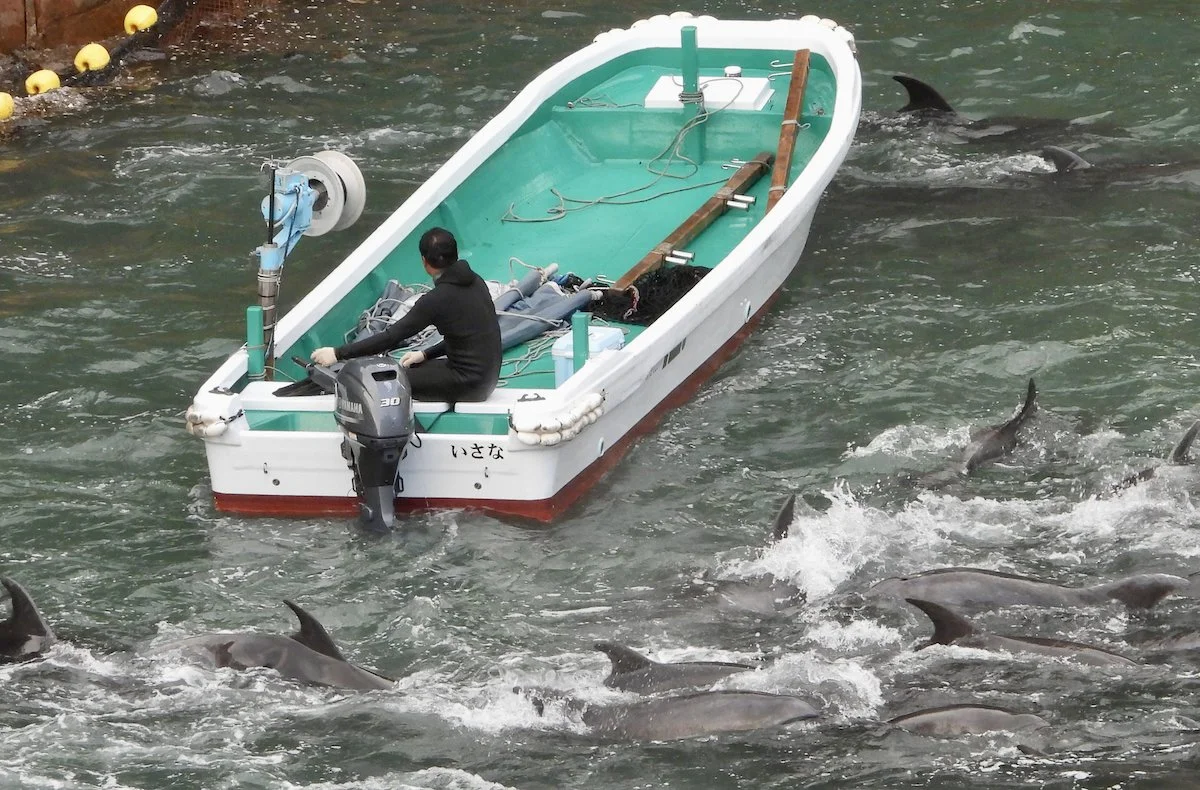
On the first day of the 2026-27 dolphin hunts, a large pod of bottlenose dolphins was found and driven into the Cove, Taiji, Japan. Credit: Rikako Fukumoto
A pod of around 20 melon-headed whales (Peponocephala electra) was driven into the cove at Taiji, Japan, and killed on October 15, during the town’s annual drive hunt, according to footage shared on Facebook by Ric O’Barry’s Dolphin Project, the Florida-based advocacy group.
Two young calves were “wrestled away from their family,” and taken back out to sea. Too young to catch fish on their own, the calves will likely now starve to death, the group says.
Japanese activists who witnessed the killing described the sights and sounds of “heartbreaking cries,” dolphins “writhing in pain,” and “violently slapping the water with their tail fins.
Two days later, hunters chased a nursery pod of Risso’s dolphins (Grampus griseus) for over three hours. Five young calves were returned to the sea, while all ten adults from the group, including mothers and helper “aunts”, were killed, says local activist Rikako, who has been filming every day since the hunts began on September 1.
On the opening day of this year’s hunting season, which runs until the end of February, 11 bottlenose dolphins were taken alive, to be sold to aquariums and marine parks, according to the Dolphin Project. Another video shows the captured dolphins being held in pens and forced to perform tricks while awaiting inspection. Trainers spent hours assessing each dolphin’s suitability for life in the entertainment industry. Those not selected are killed, say activists.
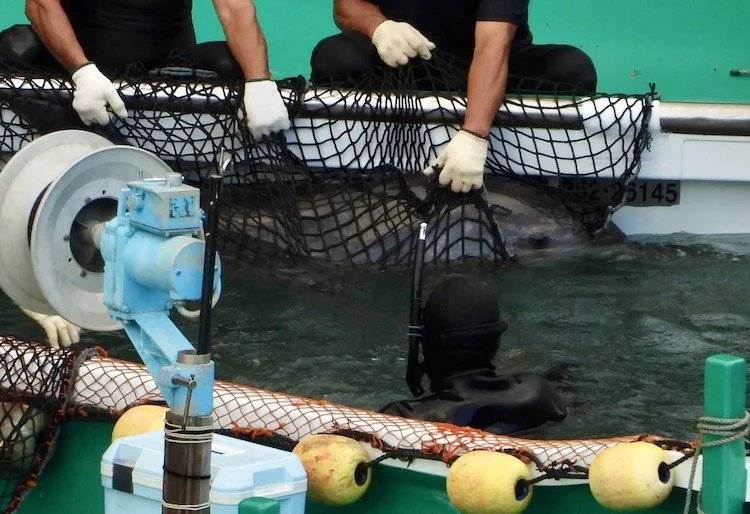
A bottlenose dolphin selected for captivity, Taiji, Japan. Credit: Rikako Fukumoto
Supporters argue that the drive hunts are a cultural tradition in Taiji, stretching back more than 400 years. One of the town’s main attractions is the government-owned Whale Museum, which celebrates Taiji’s local whaling history, and offers visitors the chance to swim with dolphins, watch dolphin shows, and purchase dolphin meat. Fishermen continue to rely on the hunt as a source of income, and many locals still enjoy eating whale and dolphin meat.
The small coastal town became a global talking-point in 2009, after the Academy Award-winning documentary The Cove exposed in graphic detail the brutal, cruel, and often prolonged deaths of dolphins and whales at the hands of knife-wielding fishermen.
In 2015, the Japanese Association of Zoos and Aquariums (JAZA) voted to bar its members from buying dolphins from Taiji. The organization had been under threat of expulsion from the World Association of Zoos and Aquariums. Of Japan’s 130 public aquariums, only 49 are currently members of JAZA.
Japanese-led activism in Taiji has been growing steadily over the past decade, with groups including Animal Liberation, Animal Rights Osaka, and Life Investigation Agency (LIA) all participating in peaceful protests during the hunt season.
When foreign activists couldn’t travel to Japan due to the Covid-19 outbreak, LIA activist Ren Yabuki moved to Taiji, where he spent every day of the 2021 hunt season documenting and livestreaming events, with his videos shared online by the Dolphin Project.
This year, new Japanese-based activists have stepped in, as Yabuki pursues a different approach. With the support of the Dolphin Project, he has filed lawsuits against Taiji Town, the dolphin hunters, and the Isana Fishery Association, which is responsible for regulating the hunting activities. All are ongoing.
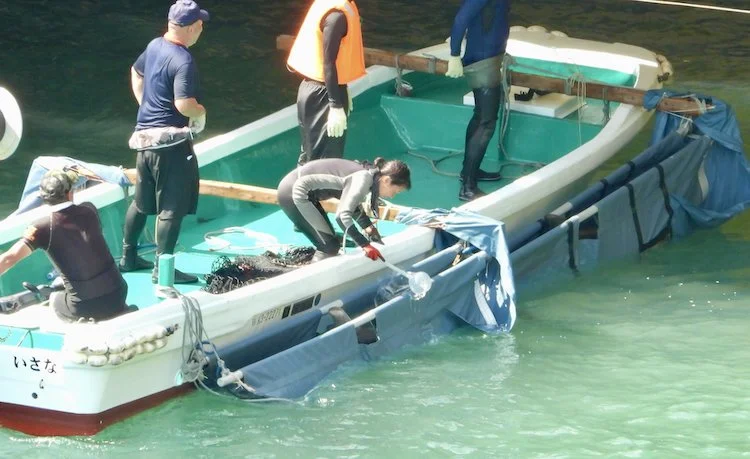
A bottlenose dolphin after being caught from the wild is selected for captivity, Taiji, Japan. Credit: Rikako Fukumoto
Yabuki blames the entertainment industry for driving demand. A dolphin can sell for around $500 for meat, whereas aquariums will pay as much as $10,000 for a live bottlenose dolphin, the easiest species to train.
According to the Dolphin Project, a public information request has revealed that the dolphin hunter’s main customer, the Taiji Municipal Development Corporation, generates 80% of its revenue through the sale of live dolphins.
The National Geographic reports that Taiji dolphins have been sold to 105 facilities across 20 countries. The U.S. has since banned the imports of wild-caught dolphins under the Marine Mammal Protection Act, and many governments have recently passed laws to phase out dolphinariums – including Mexico, one of the world’s most popular destinations for watching dolphin shows and swimming alongside them.
However, while as many as 80 global dolphinariums have closed down, new facilities are opening up in other parts of the world, where the keeping of dolphins remains legal.
Since 2002, the Ukrainian-based company Nemo has opened in excess of 30 dolphinariums in such countries as Armenia, Azerbaijan, Belarus, China, Qatar, Russia, Thailand, Ukraine, and Uzbekistan. Its most recent dolphinarium opened in Quanzhou, China, in 2021. T
he Nerum corporation, which owns the Nemo chain of dolphinariums, acquires the dolphins from Taiji. An export license from September 2010 shows that 16 live Taiji bottlenose dolphins were purchased by Nerum for a total of $192,000.
With animal stories making up less than 2% of the news cycle, we're here to fill that gap. Sign up for Species Unite’s weekly news digest.
The animals need a newsroom in their corner
Every week we dig into the animal stories the mainstream news overlooks. Investigations, exposés, legal battles, and victories - none of it happens without your support. A monthly gift of as little as $5 keeps us covering the 98% of animal news the world isn't seeing.
More stories:
Pronghorn have used the overpass to cross Interstate 25 safely for the first time in 30 years, while bears, coyotes, deer, elk, moose, frogs, and a threatened species of mouse have also been taking advantage of the $15 million crossing.