
Deformed 'monster' foxes still being bred on Finland's fur farms, footage shows
Fur farmers had previously pledged to stop breeding abnormally large foxes, but campaigners say the apparent lack of reform strengthens the case for the European Union to ban the fur industry.
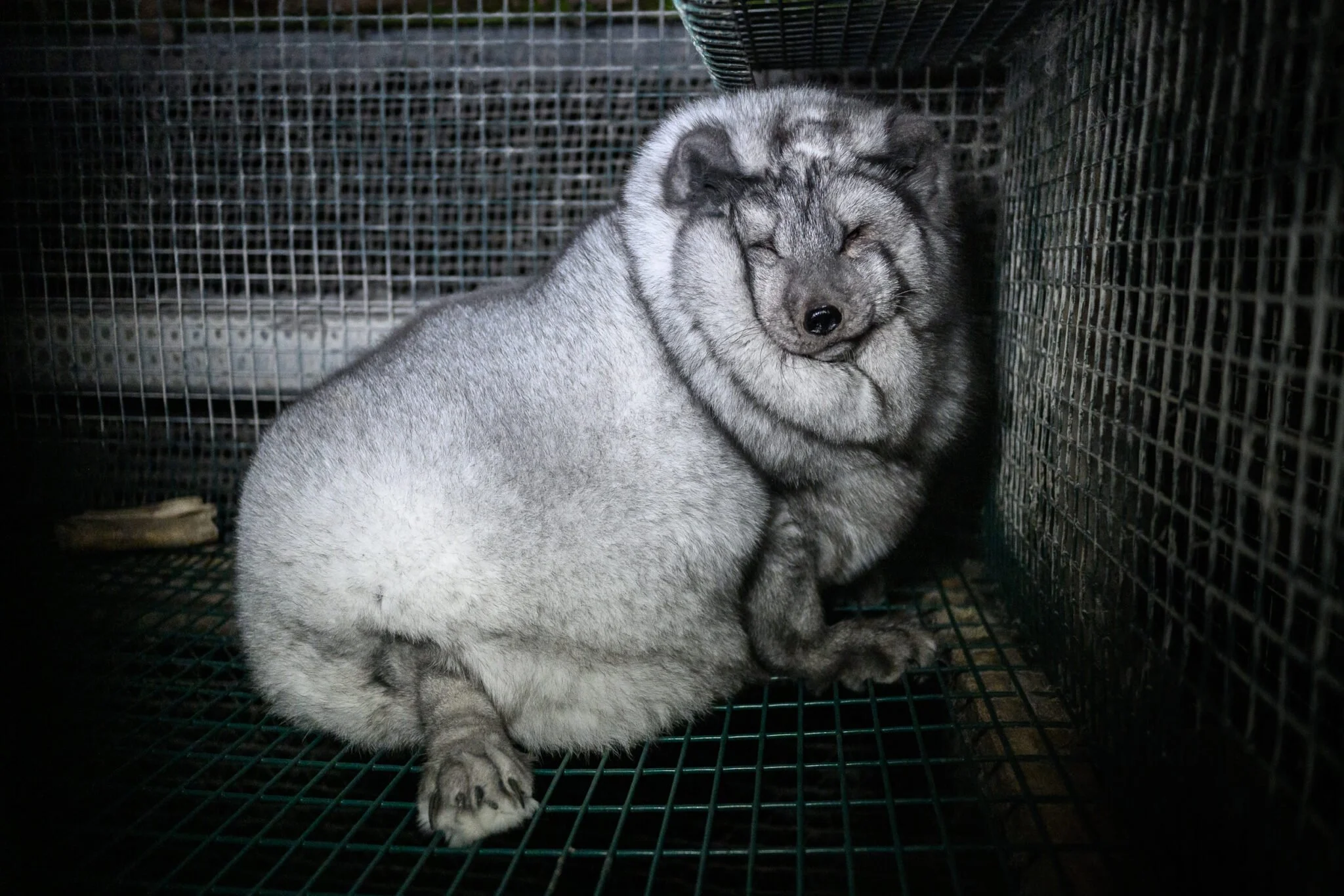
A ‘monster’ fox confined in a wire cage on a Finnish fur farm. Credit: Project 1882
Foxes bred to abnormal sizes remain confined on Finnish fur farms, despite farmers' pledges to stop the controversial practice, newly released undercover footage shows.
Recorded by an anonymous source at fox farms in Kauhava, Lapua, and Veteli between November 2025 and April 2026, and provided to the animal advocacy organization Project 1882, the footage shows abnormally large foxes confined in tiny wire cages. The animals, referred to as ‘monster’ foxes, are so grossly overweight that their skin sags in heavy folds, and they struggle to move.
“These foxes are literally being deformed to produce a few extra centimetres of fur. This is how far this industry is prepared to go to increase its profits,” said Sébastien de Jonge, Director of Operations of GAIA (Global Action in the Interest of Animals).
Arctic foxes have been selectively bred over recent decades for traits such as rapid growth and greater size to produce larger pelts. Farmers in Finland pledged to stop breeding oversized foxes after the practice first came to light in 2017, when images of Arctic foxes bred to abnormal sizes drew widespread public condemnation.
In response, the Finnish Fur Farmers' Association PROFUR (now FIFUR) introduced maximum pelt lengths of 155–160cm and a body index monitoring system across the industry.
According to a recent report by the European Food Safety Authority, Arctic foxes bred for their fur in the 1990s weighed around 7kg at pelting, but by 2014, they weighed as much as 20kg. Foxes with higher fat deposition or faster daily weight gain are more likely to suffer from bent feet, front leg turn, and osteochondrosis.
The report also found that single cages are usually narrower than the total length of an Arctic fox, and that movement restrictions are further exacerbated by wire-mesh flooring as well as low cage height (approximately 70cm).
"For years, the fur industry has faced criticism and promised reform, yet foxes continue to be born into lives of confinement and suffering, only to be killed for their fur,” said Benny Andersson, CEO of Project 1882, the organization who released the footage last week.
The Finnish Animal Welfare Act prohibits breeding practices that “cause physical or psychological harm to animals.” Yet according to Project 1882, the footage shows foxes suffering from severe eye infections, untreated injuries, and heavily impaired mobility. In one particular image, two oversized foxes are confined in the same wire cage.
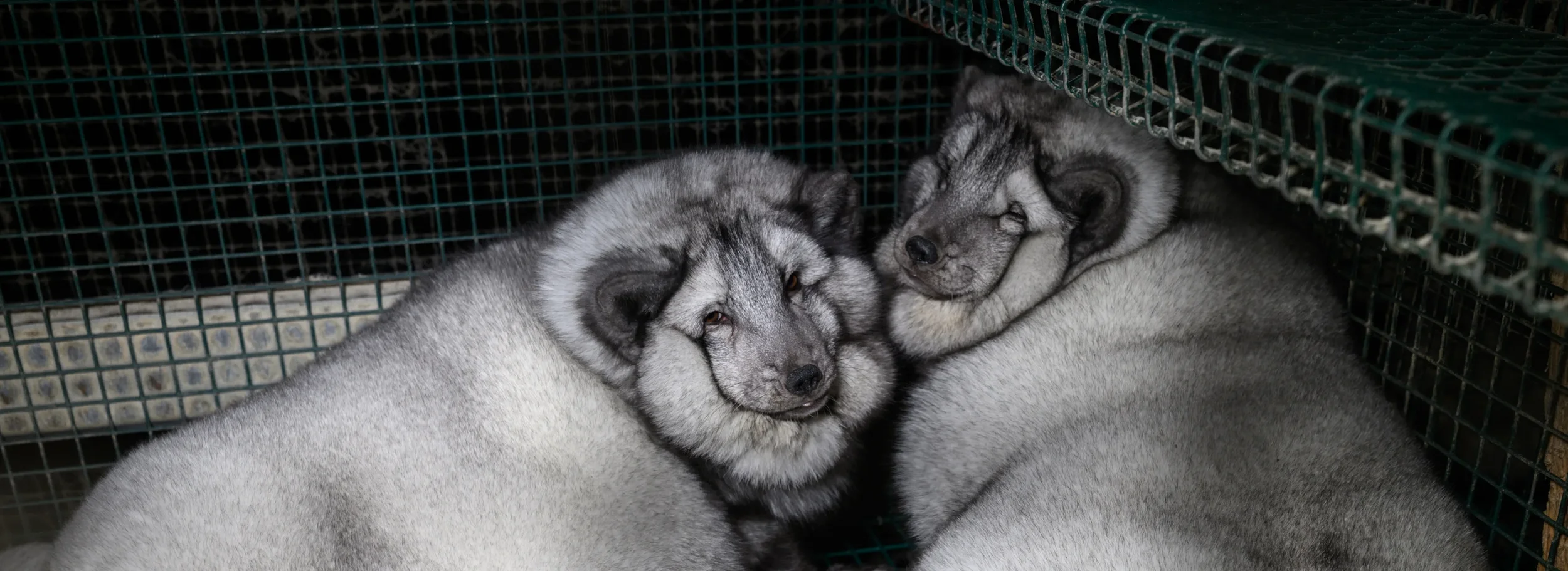
Two oversized foxes confined together in a single wire cage on a Finnish fur farm. Credit: Project 1882
“As the EU [European Union] decides the future of this industry, the question is not whether change is needed, but how many more animals must suffer and die before policymakers finally act to end fur farming once and for all,” said Andersson.
The European Citizens’ Initiative for a Fur Free Europe – which attracted over 1.5 million signatories – has called on the EU to ban fur farms and to ban the sale of fur products in Europe. An outcome was expected in March of this year, but the EU has delayed its decision until after the summer.
Finland is one of the last remaining European countries in which fur farming remains legal, and is the largest producer of certified fox furs in the world. However, according to FIFUR’s latest statistics, annual exports of fox fur are on a downward trend. Over the past three years, around EUR60 million was exported each year from 2022 to 2024 – down from EUR 110 million in 2021 and EUR 190 million in 2017.
Over the past decade, the fashion industry – among the primary consumers of fur – has been phasing out natural fur products, with bans imposed by Giorgio Armani (2016); Gucci (2018); Prada (2020); Adidas (2021); and Dolce & Gabbana (2022), among many others, including leading high-street retailers, reflecting consumer concerns over the economic, environmental, and animal welfare impacts of fur farming.
Opinion polls commissioned by FIFUR and carried out by independent companies between 2009 and 2025 show that only 40 percent of Finns now support fur farming – down from a previous high of 65 percent.
Dolce & Gabbana, Armani, Prada, Valentino, Versace, and so many other major fashion brands and designers that have made the choice to go fur-free. Despite this, Fendi continues to sell products made from the skins of minks, foxes, sables, chinchillas, and even bobcats. Sign the Species Unite petition calling on Fendi to drop fur.
With animal stories making up less than 2% of the news cycle, we're here to fill that gap. Sign up for Species Unite’s weekly news digest.
The animals need a newsroom in their corner
Every week we dig into the animal stories the mainstream news overlooks. Investigations, exposés, legal battles, and victories - none of it happens without your support. A monthly gift of as little as $5 keeps us covering the 98% of animal news the world isn't seeing.
More stories:

A cleaner New York Harbor has drawn hundreds of humpback whales back to its waters for the first time in generations, but the same busy port that welcomes them is also killing them.