
New bipartisan bill aims to end taxpayer-funded testing on dogs and cats
After years of public outcry against the cruel breeding of dogs for laboratory testing, the fight for companion animals trapped in the biomedical research industry is gaining momentum. Earlier this year, Ridglan Farms in Wisconsin finally closed after nearly six decades of breeding beagles for laboratory experimentation, with more than 2,000 dogs rescued and given the chance to find loving homes. More recently, Chewy dropped Marshall Pet Products following a long campaign by advocates, including Species Unite, over the brand’s connection to Marshall BioResources, one of the largest breeders of animals for experimentation in the United States.
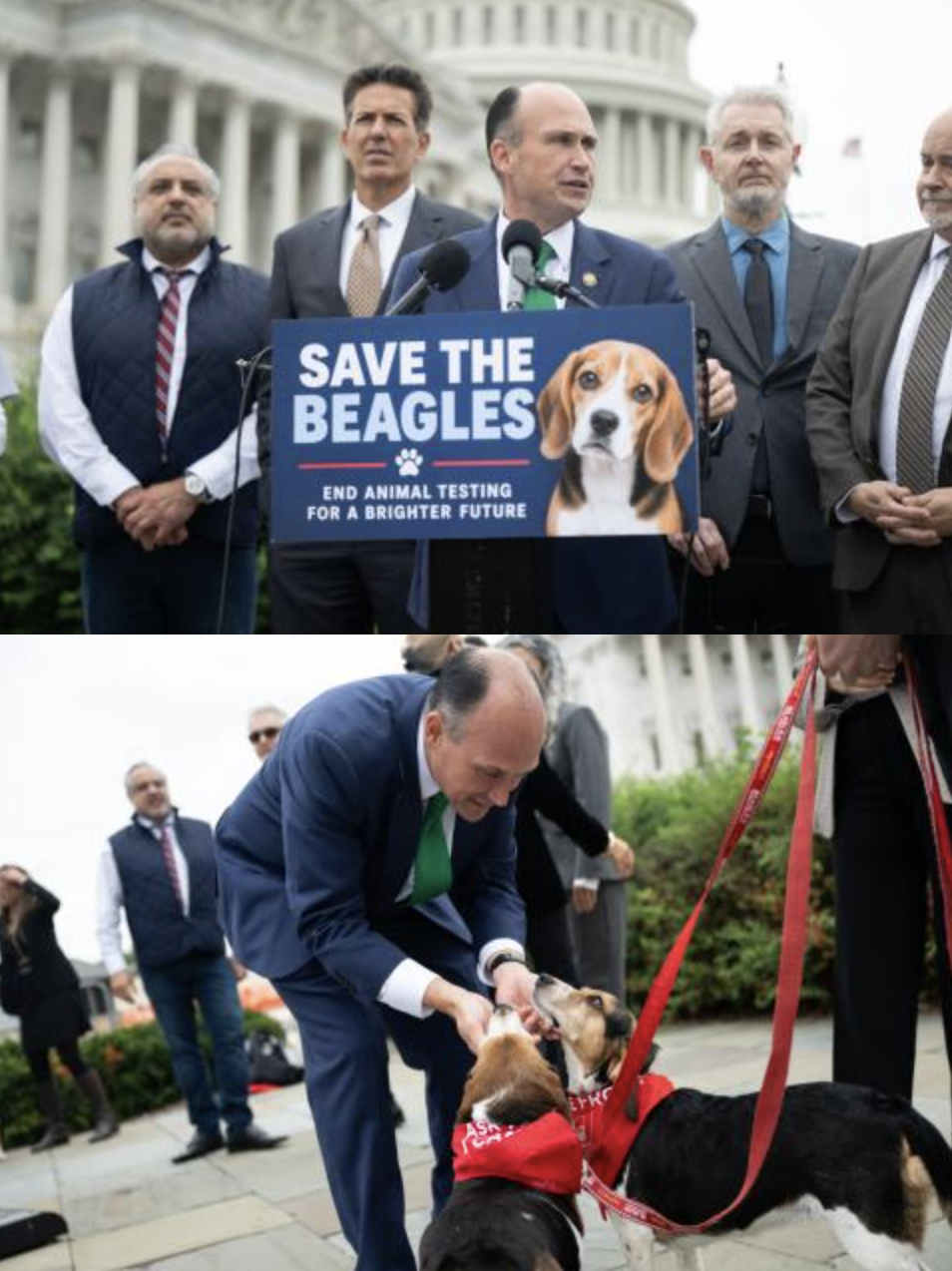
Credit: Office of Rep. Nick Langworthy
The movement against breeding and testing on dogs and cats came to a head last month as dozens of activists marched 207 miles from New York’s capital in Albany over two weeks to join hundreds of protesters outside Marshall BioResources in western New York on September 26. The major public demonstration was a powerful show of the widespread opposition to animal testing and the cruel breeding facilities that supply animals to laboratories. As the march was underway, members of the United States Congress were taking up the same cause in Washington.
On September 23, Representatives Nick Langworthy (R-NY) and Mark Pocan (D-WI) introduced the bipartisan Companion Animal Protection Against Cruel Testing (COMPACT) Act, legislation that would end federal funding for biomedical research involving live dogs and cats while strengthening protections for animals already held in research facilities.
The COMPACT Act was announced at a press conference attended by beagles rescued from Ridglan Farms and representatives from a wide range of animal advocacy organizations. Both lawmakers made clear that recent revelations about conditions at dog breeding facilities were the driving force behind the bill.
“The horrific abuse and barbaric treatment of beagles uncovered inside research facilities like Ridglan Farms and Marshall BioResources has outraged Americans from every corner of the country and political spectrum,” Congressman Langworthy said.
“What happened at Ridglan Farms was a wake-up call for our community and for the country,” Congressman Pocan said. “We saw thousands of beagles confined in inhumane conditions and bred for research, and we saw what was possible when people came together to demand change.”
So far, the bill has gained bipartisan support, with 12 cosponsors in just two weeks, and has the backing of animal welfare organizations across the country. Its sponsors describe the COMPACT Act as the most comprehensive legislation to date aimed at protecting companion animals in the animal testing pipeline.
If passed, the COMPACT Act would:
Prohibit the use of federal funds administered by the Department of Health and Human Services and relevant subagencies for research involving live dogs and cats, including grants, contracts, fellowships, and other funding mechanisms.
Protect and rehome animals currently being used for biomedical testing, giving them the opportunity to live outside research facilities.
Strengthen compliance and oversight mechanisms and provide law enforcement with tools to protect dogs and cats from taxpayer-funded experimentation.
Increase transparency and accountability through annual reporting by HHS and a Government Accountability Office review three years after enactment.
Establish standards and transition provisions to help research institutions move toward modern, non-animal research methods.
Wayne Hsiung, an animal rights attorney and co-founder of Direct Action Everywhere who played a key role in the Ridglan rescue campaign, welcomed the legislation, highlighting the millions of dollars in public funding used for experiments on dogs.
“Americans have been paying $40 million a year to fund cruel experiments on dogs and most have no idea,” Hsiung said. “The COMPACT Act finally puts taxpayers back in control of their own money, and ends a program the science stopped justifying long ago.”
The introduction of the COMPACT Act is an important step forward, but the fight is far from over. The bill must still make its way through Congress, and in the meantime, thousands of dogs, cats, and other animals are being bred and sold to laboratories.
Species Unite will continue to speak out against this cruel industry and hold the companies that support it accountable. If you have not already, please sign and share our petition calling on Marshall BioResources to stop breeding dogs and other animals for experimentation. Your voice can help build the public pressure needed to end animal suffering in the name of experimentation.