
Barred owl killing moves forward despite legal challenge as Oregon launches its own program
Since the U.S. Fish and Wildlife Service approved its cruel and ill-advised plan in 2024 to kill nearly half a million barred owls over the next 30 years, Species Unite and other animal advocacy, bird conservation, and environmental organizations have been fighting to stop this unprecedented slaughter. Now, despite years of opposition and a pending legal challenge, the killing appears to be underway, the federal government has reportedly declined to disclose how many owls have been killed so far, and Oregon has launched its own program to kill hundreds more.
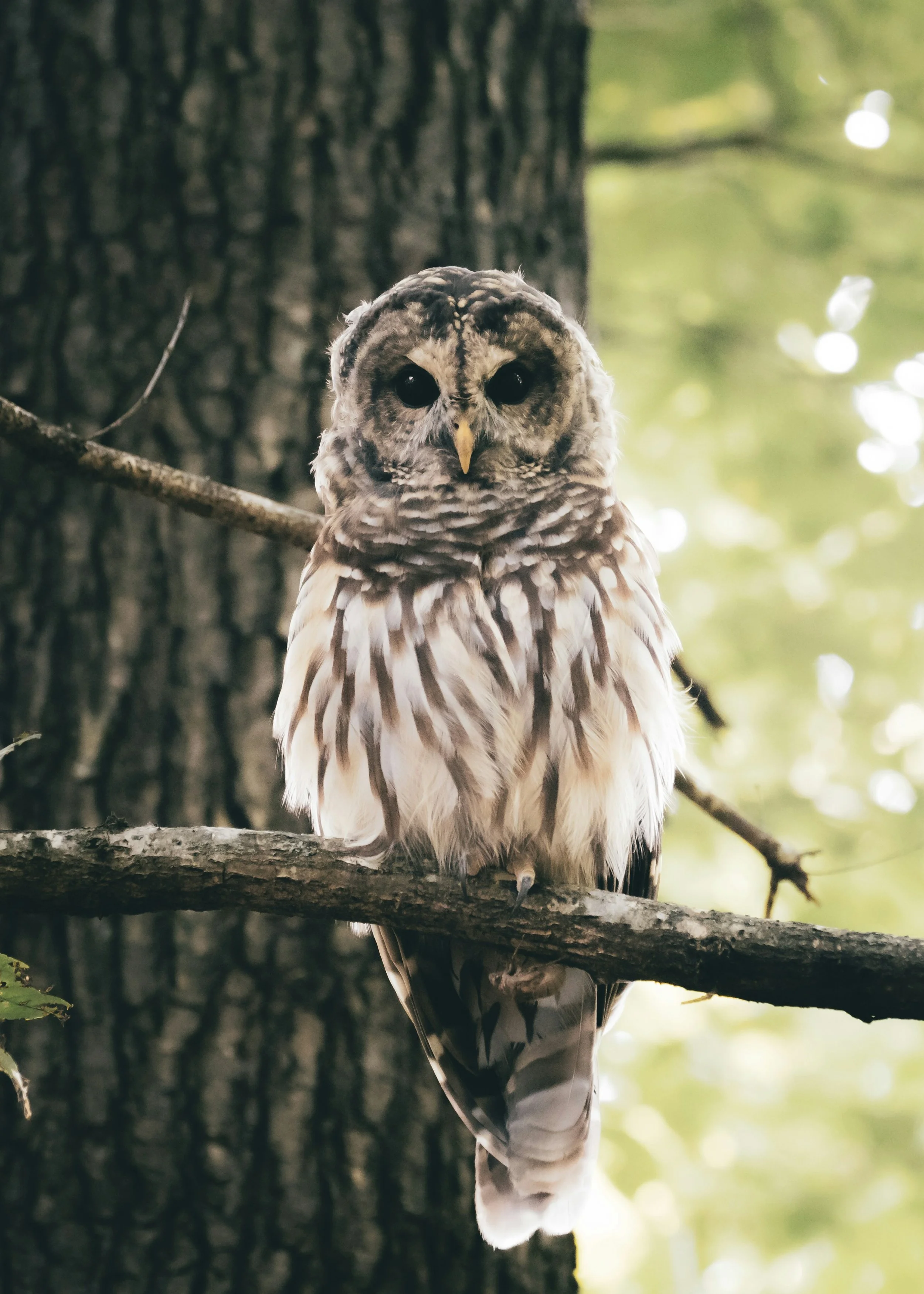
The federal government claims that killing barred owls will help save the threatened northern spotted owl, whose population has declined dramatically. The two species now compete more directly for territory, food, and nesting sites across the Pacific Northwest, with the smaller northern spotted owl struggling to compete with its larger relative. However, the crisis facing northern spotted owls is rooted in decades of habitat loss and fragmentation caused by logging of the old-growth forests they depend on, while barred owls have expanded their range into the Pacific Northwest as environmental changes, including the spread of new-growth forests across the Great Plains, wildfires, and climate change, have altered the landscape.
Rather than addressing these underlying problems, the federal government’s Barred Owl Management Strategy, or BOMS plan, authorizes trained shooters to kill up to 450,000 barred owls across Oregon, Washington, and California over the next 30 years. Barred owls are native to North America, and their range expansion is a natural ecological process. Critics argue that labeling them an “invasive species” unfairly turns these birds into scapegoats for an environmental crisis caused largely by human activity. The plan also raises serious concerns about the risk of accidentally killing northern spotted owls and other owl species that can be difficult to distinguish from barred owls, as well as the disruption of nesting behavior and other unintended consequences for forest ecosystems.
In June, Friends of Animals, which sued to stop the plan, argued its case before U.S. District Judge Adrienne Nelson in Portland, but the judge has yet to issue a ruling. As Friends of Animals attorney Jennifer Best has noted, with no court order in place to stop the killing, the government has indicated that it is moving forward with the plan while the case remains pending.
In September, the Center for a Humane Economy launched a multi-state “Hoot, Don’t Shoot” billboard campaign, placing 17 billboards across California, Idaho, Oregon, and Washington to raise awareness and urge the public to oppose the federal plan. The organization has reported that the federal government is already spending millions of taxpayer dollars to deploy shooting teams on public lands and tribal reservations, yet it has refused to disclose the number of owls killed despite repeated Freedom of Information Act requests. The lack of transparency makes it difficult for the public to understand the scale of the killing or assess its consequences.
Now, the killing has expanded to state-owned land. On October 1, Oregon began its own barred owl killing program in the 83,000-acre Elliott State Research Forest, where contractors are authorized to kill up to 350 barred owls over the coming year. Amy Price, a research biologist at the forest, explained that state officials chose to follow the federal strategy rather than develop their own approach, saying, “We are using the U.S. Fish and Wildlife Service’s management strategy. We could have come up with our own strategy, but we chose to follow them, because the science has already been done.”
This is deeply troubling given the serious questions that remain about the plan’s effectiveness, the risks to other owls and wildlife, and whether killing barred owls will deliver lasting benefits for northern spotted owls. The Oregon program is expected to cost approximately $240,000 over its first 16 months alone, with no guarantee that the effort will ultimately reverse the northern spotted owl’s decline.
All of this is happening while the government rolls back protections for the forests spotted owls need to survive. In September, a Fish and Wildlife Service rule took effect rescinding the regulatory definition of “harm” under the Endangered Species Act, which had allowed certain habitat modifications to be treated as harm to protected wildlife. Meanwhile, the Agriculture Department has proposed rescinding the Roadless Rule, which restricts road building and timber harvesting in tens of millions of acres of national forest. Killing hundreds of thousands of owls who have simply adapted to an altered landscape will never be a substitute for protecting the forests spotted owls depend on, and it cannot be allowed to distract from the logging and habitat destruction driving this crisis.
As the legal challenge continues and the killing spreads, it is more important than ever to demand a different approach, one that protects northern spotted owls by addressing habitat destruction rather than subjecting barred owls to a decades-long killing campaign.