
New footage shows long-tailed macaques captured in their natural habitats to be sold to US laboratories, leading animal advocates to urge for the resignation of the CITES Secretary-General.
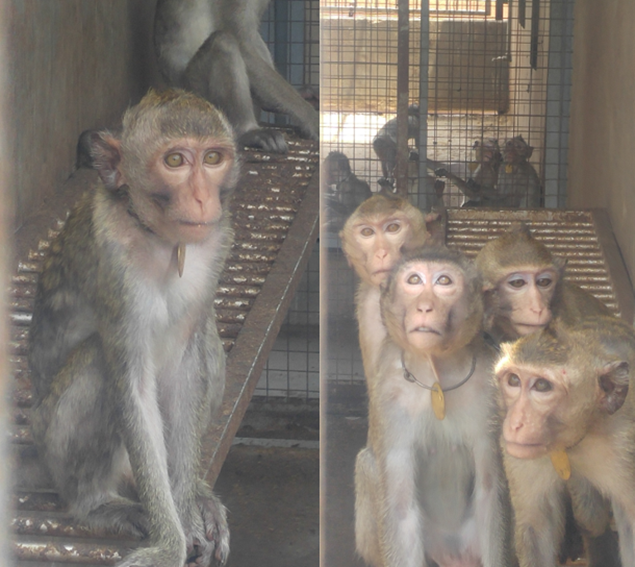
Endangered long-tailed macaques, destined for export, are confined inside filthy concrete enclosures at a Cambodian monkey farm. Image obtained by PETA.
An undercover video released by PETA has revealed monkeys taken from their homes in the wild throughout Southeast Asia to be smuggled overseas for use in experimentation.
The damning footage shows the animals shoved into trunks and transported internationally, transiting through territories such as Cambodia.
Despite this, the Convention on International Trade in Flora and Fauna, a global treaty that aims to protect wildlife from exploitation and abusive trade (CITES), Secretary-General Ivonn Higuero recently recommended to drop the scrutiny of the monkey trade in Cambodia, Vietnam, and the Philippines.
The recommendation has led to PETA and Spanish anti-vivisection organization Abolición Vivisección to join together to call for Higuero to resign.
In their letter to the CITES Secretariat, the animal-defending organizations remind that one of the main aims of CITES is to ensure that all wildlife trade remains legal, transparent, and non-threatening to species survival – and the recommendation to remove these countries from review directly counteracts that aim.
“CITES leaders are choosing to ignore overwhelming evidence that facilities in Southeast Asia are smuggling endangered monkeys—even as Thai authorities just last week seized trafficked macaques from smugglers’ vehicles headed to Cambodian self-described ‘breeding facilities’,” says PETA Senior Science Advisor on Primate Experimentation Dr. Lisa Jones-Engel. “CITES must restore credibility by replacing its Secretary-General and immediately suspending all macaque exports.”
In the undercover video, traffickers were seen transporting monkeys in nylon bags in the truck of a car. Animals who weren't fit for trafficking due to injury, illness, or being the wrong species were killed, and their bodies burned to conceal the evidence of the trafficking.
This month, wildlife-crime authorities in Thailand intercepted two shipments containing 143 long-tailed macaques being trafficked into Cambodia.
PETA and Abolición Vivisección's letter reads, “For the Secretariat to recommend clearing Cambodia from review while this active trafficking route is being exposed is indefensible. It demonstrates not only a failure to act on existing evidence but an unwillingness to respond even when that evidence materializes in plain sight.”
The letter goes on to mention that the decision is even more indefensible considering the 2025 reassessment of endangered species by the International Union for Conservation of Nature’s (IUCN), which elevated the long-tailed macaque from Endangered A3cd to Endangered A2cd+3cd+4cd,3 meaning that this is a species at “very high risk of extinction in the wild.”
The evidence of corrupt trade in Cambodia is robust and goes back a long time: for years, discrepancies have been noted in the number of long-tailed macaques in Cambodian breeding facilities and the numbers of animals the country has exported under CITES.
The CITES Secretariat has relied on information about animal trade provided by the very facilities that found themselves at the centre of the trafficking – during a recent visit to Cambodia, Higuero concluded that there was “no evidence of wild animals being laundered or captive-bred”. She subsequently advised the Standing Committee to end its scrutiny of Cambodian monkey trading, along with other territories.
The US plays a key role in this scandal: an investigation by the US Fish and Wildlife Service has found that approximately 30,000 long-tailed caught in the wild in Cambodia were illegally brought into the United States through Cambodian breeding operations.
In these trades, falsified CITES permits were used. These animals are sent on to US laboratories for cruel, unnecessary and pointless experiments on animals, which will see these animals killed in the end.
Trafficking of monkeys from Cambodia to the US ended in 2022, but PETA reports that these imports have recently resumed, with the animals allegedly going to Charles River Laboratories, which has repeatedly come under fire for its reported involvement in monkey trafficking.
PETA and Abolición Vivisección's letter concludes, “CITES can restore its authority only by confronting the evidence, suspending macaque exports, initiating an independent investigation into the Southeast Asian trade, and replacing leadership that has failed to act. Anything less will confirm that the Treaty is no longer protecting wildlife, but those who profit from exploiting it.”
What can you do?
Watch and share: 30,000 Monkeys in Our Backyard. This new Species Unite documentary exposes the hidden realities of the animal research trade and reveals what happens when corporate power meets small-town America.
Demand the U.S. government ban monkey imports from Cambodia. Sign here.
We Have A Favor To Ask…
Species Unite amplifies well-researched solutions to some of the most abusive animal industries operating today.
At this crucial moment, with worldwide momentum for change building, it’s vital we share these animal-free solutions with the world - and we need your help.
We’re a nonprofit, and so to keep sharing these solutions, we’re relying on you - with your support, we can continue our essential work in growing a powerful community of animal advocates this year.

A cattle truck crash in Kansas City, Missouri, is one of several recent ones, as Mercy for Animals urges the US Department of Agriculture to update its rules on animal transport.