
This week, in a historic moment in the fight for freedom for elephants, the Hawaiʻi Supreme Court heard oral arguments in Nonhuman Rights Project, Inc. v. City and County of Honolulu. The Nonhuman Rights Project (NhRP) is arguing that Mari and Vaigai, two Asian elephants who were born in the wild, captured as babies, and have since spent decades in captivity at the Honolulu Zoo, have a common law right to bodily liberty based on their complex intellect, their physical and psychological needs, and the high level of self-awareness that the most recent animal science has proven they possess. NhRP filed a habeas corpus petition on behalf of the two elephants, a legal remedy typically used to protect humans from unlawful imprisonment, and is pushing for them to be transferred to an accredited sanctuary where they would have more space, more appropriate living conditions, and the ability to engage in more natural behaviors.
The hearing took place at Punahou School as part of Hawaiʻi’s Courts in the Community program, which teaches young people about the judicial process, and was witnessed by more than 450 students from 11 local high schools, along with members of the community and local and national media. Members of the Species Unite team were also there as part of the media pool capturing footage for our upcoming feature-length documentary, which follows NhRP’s groundbreaking legal work on behalf of elephants and sheds light on the suffering these animals experience in captivity.
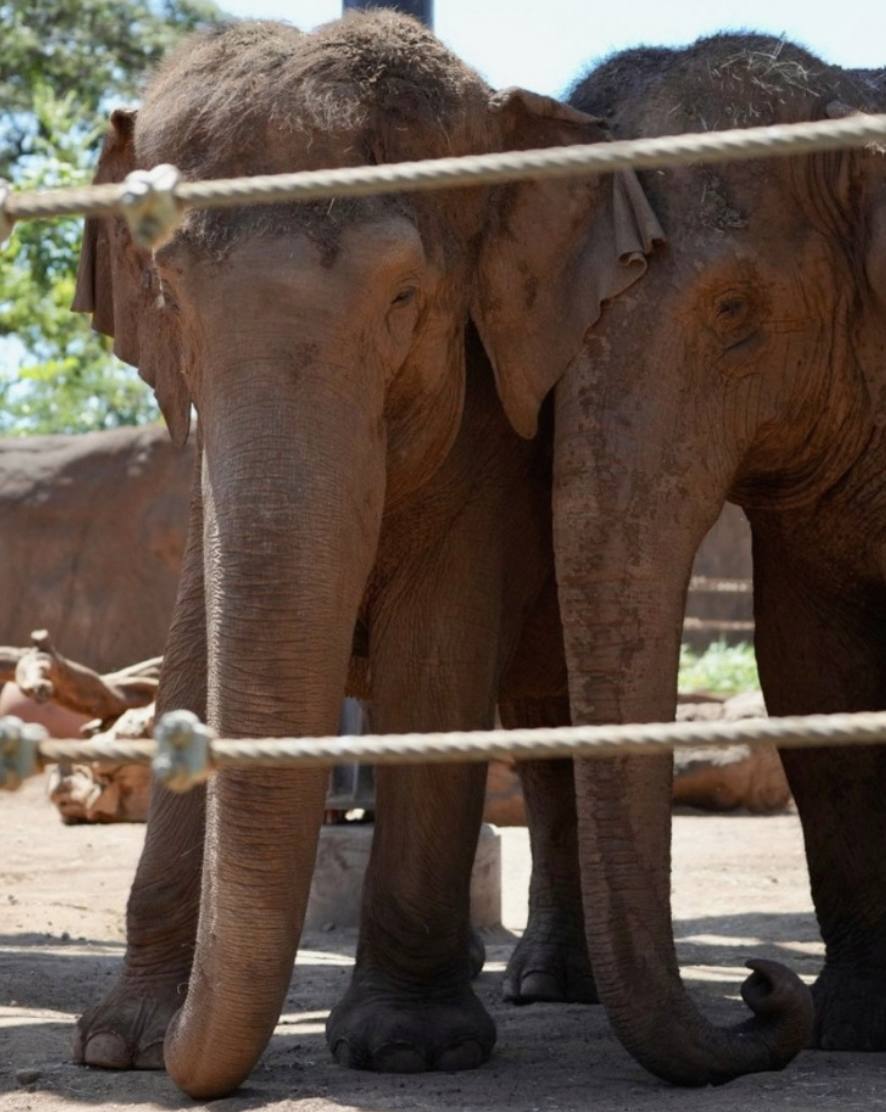
Credit: Nonhuman Rights Project
NhRP’s case for Mari and Vaigai
NhRP Senior Staff Attorney Jake Davis spoke eloquently about the historical precedent for courts allowing the law to evolve and extend the promise of liberty to new groups. The justices’ main concern was whether granting habeas corpus to Mari and Vaigai would open the floodgates to legal challenges on behalf of all kinds of intelligent animals, such as pigs and octopuses. Davis gave a clear and solid response, explaining that “the beauty of habeas corpus is that it is an inherently case-specific determination.”
NhRP has been consistent that this case is only about the unlawful confinement of Mari and Vaigai at the Honolulu Zoo, a facility that has repeatedly appeared on In Defense of Animals’ list of the 10 worst zoos for elephants during their many years there. They have argued that just as a habeas ruling that frees one person from prison does not lead to every other prisoner being released, a ruling for these two elephants would not automatically apply to others. Davis urged the court to focus on the case before it rather than speculation about the future, pushing back powerfully that “an unfounded fear of the future should never prevent a court from adjudicating a liberty interest.”
The City’s arguments
Representing the City and County of Honolulu, Deputy Corporation Counsel Patricia Sendao made few compelling arguments, and the justices offered a great deal of pushback on the City’s position.
Sendao’s central argument was that decisions about animal welfare should be left to the legislature, essentially arguing that the very court hearing the case should have no role in deciding it. She also pointed out that the zoo was not violating any existing law, which is precisely why NhRP is asking the court to recognize a new understanding of the law. The justices questioned whether the City was suggesting the court was powerless in cases like this, with Associate Justice Sabrina McKenna raising the case of Rusty, an orangutan who spent seven years in a tiny cage at the Honolulu Zoo. She asked whether, if a habeas case had been brought on his behalf, the court would have been expected to wait for Congress, the state legislature, or the City Council to act. When Sendao suggested there were other avenues for holding zoos accountable, Justice McKenna explained that those options are extremely limited, since the federal Animal Welfare Act can only be enforced by the U.S. Department of Agriculture, leaving individuals with no way to enforce it themselves. She reminded Sendao that “this court can establish new rights under the common law that the legislature has not recognized.”
Sendao also pointed to NhRP’s losses in similar elephant cases in New York, Colorado, and elsewhere, an argument the justices dismissed right out of the gate. As Davis began to address the issue, Associate Justice Todd Eddins stepped in and offered to answer it for him so he could move on to other points. Justice Eddins made it clear that previous rulings in other states would carry little weight, noting that the Hawaiʻi Supreme Court does “not work on a scorecard system” and has previously made monumental decisions to protect the rights of both people and nature that went beyond the findings of other courts.
Sendao went on to claim that because there is no precedent for applying habeas corpus to animals in the United States, NhRP was trying to create a new right out of thin air. Justice McKenna challenged this as well, asking, “Why would it be out of thin air when there are at least two international courts that have recognized and applied the writ of habeas corpus to animals?” When Sendao responded that those rulings were based on other nations’ constitutions, Justice McKenna shared a beautiful reflection on Hawaiʻi’s own constitution, which is unique in its mandate to respect Hawaiian culture and refers to “Divine Guidance” rather than “God” or “the Almighty.” Unlike constitutions grounded in western cosmology, in which animals are beasts to be dominated, she noted that in Hawaiian culture “animals are considered our relatives,” and she pointedly asked whether that culture should not be considered in this case, as the state constitution requires.
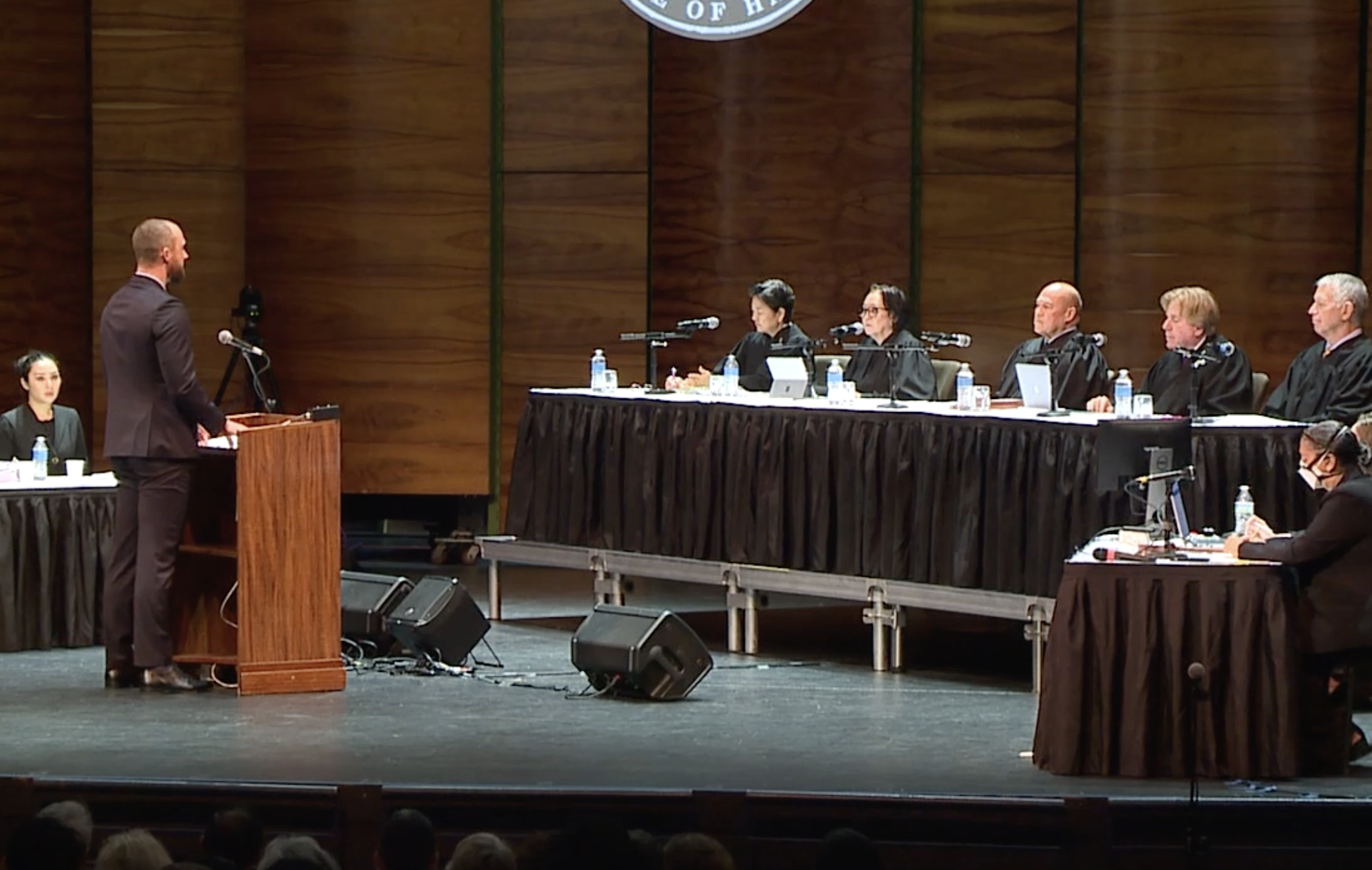
NhRP Senior Staff Attorney Jake Davis addresses the Hawaiʻi Supreme Court
Responding to the City’s position that only humans can be legal persons, Davis noted that ships and corporations have been recognized as legal persons, as have companion animals under some state statutes, and that international courts have also recognized the personhood of certain animals. Justice McKenna also pointed to a 2010 U.S. Supreme Court ruling which recognized corporations as persons for purposes of free speech.
Closing arguments
In closing, Davis reiterated the power of the courts to interpret the constitution in a way that evolves with our understanding of justice. Just as the rights of different groups of people have been affirmed in court before the law could catch up, he argued, we now have scientific evidence that elephants like Mari and Vaigai should have the right to bodily liberty. He ended on a profound note, focused on the hundreds of students gathered to watch: “The question before us is what would we be asking these impressionable minds behind me to bear witness to, what would we be telling these impressionable minds about our moral life, to deny two innocent beings an evidentiary hearing they are entitled simply because they have the wrong biology.”
What happens next
The Hawaiʻi Supreme Court will now decide whether to move forward with an evidentiary hearing, where NhRP would be able to present its full range of evidence on why Mari and Vaigai are being unlawfully confined. There is no set date for that decision, but the compassionate and thoughtful remarks from the justices, particularly Justice McKenna, left our team feeling hopeful about the possibility of this case moving forward.
Species Unite will continue to follow NhRP’s work for Mari, Vaigai, and all the elephants they represent as our film progresses, and we will keep you informed of the progress and setbacks in this monumental fight for freedom and a new understanding of who is entitled to liberty under the law.
Thank you for speaking out for elephants and supporting our film. If you haven’t already, here are four actions you can take to make a difference for these majestic animals: